Support our educational content for free when you purchase through links on our site. Learn more
🚗 How Mileage Affects a Car Lease: The $2,40 Shock You Need to Know

Your monthly lease payment and final bill are directly dictated by your odometer, meaning driving just 5,0 extra miles a year can skyrocket your costs by hundreds of dollars. Understanding how mileage affects a car lease is the single most important factor in avoiding a massive surprise fee when you return your vehicle.
Many drivers assume the “12,0 miles per year” standard is a suggestion, but it’s actually a hard financial contract. We once had a client who thought a few extra road trips wouldn’t matter, only to face a $2,40 penalty at the end of his term because he drove 18,0 miles annually instead of 12,0. That’s the price of a luxury vacation, or in his case, a very expensive lesson in math.
Leasing companies calculate your monthly payment based on the car’s projected residual value, which drops significantly as mileage increases. If you exceed your agreed limit, you aren’t just paying for the extra wear; you’re paying a premium rate that can range from 15 to 30 cents per mile.
Key Takeaways
- Higher mileage caps equal higher monthly payments because the car’s estimated future value (residual) is lower.
- Excess mileage fees can cost between $0.15 and $0.30 per mile, often totaling thousands of dollars if ignored.
- Pre-purchasing extra miles during the lease is almost always cheaper than paying the penalty at the end.
- Selling the car privately before turning it in can sometimes save you money if the market value covers the overage fees.
- Track your odometer every six months to avoid the “shock” of an unexpected final bill.
Table of Contents
- ⚡️ Quick Tips and Facts
- 📜 The History of Mileage Caps: From Horse-Drawn to Horsepower
- 🚗 How Mileage Limits Shape Your Monthly Lease Payment
- 📉 The Math Behind the Mileage: Understanding Excess Charges
- 🛣️ Choosing the Right Mileage Tier: 10k vs. 12k vs. 15k
- 🚫 What Happens If You Go Over? The Shocking Truth About Overage Fees
- 🛠️ Can You Buy More Miles? Mid-Lease Mileage Adjustments Explained
- 🔄 Trading In Early: How Mileage Affects Your Turn-In Value
- 🛡️ Protecting Your Wallet: Strategies to Avoid Mileage Penalties
- 🆚 Lease vs. Buy: Does High Mileage Make Ownership a Better Deal?
- 📊 Real-World Scenarios: Commuters, Road Trippers, and Gig Drivers
- 🧐 Common Myths About Car Lease Mileage Debunked
- ✅ Quick Tips and Facts
- 🏁 Conclusion
- 🔗 Recommended Links
- ❓ FAQ
- 📚 Reference Links
⚡️ Quick Tips and Facts
Before we dive into the nitty-gritty of odometer readings and contract fine print, let’s hit the high notes so you don’t get stuck in a traffic jam of confusion.
- The Golden Rule: Your monthly payment is directly tied to how many miles you drive. More miles = lower residual value = higher monthly payment.
- The Standard Tiers: Most leases default to 10,0, 12,0, or 15,0 miles per year. Anything else usually costs extra upfront.
- The Overage Shock: If you go over, you aren’t just paying a fee; you’re paying a penalty rate that can range from $0.15 to $0.30 per mile. That adds up faster than you think!
- The “Buy More Miles” Hack: It is almost always cheaper to pre-purchase additional miles at the start of the lease than to pay the penalty at the end.
- The Lophole: If you exceed your limit, selling the car privately might be cheaper than turning it in, provided the market value is high enough to cover the overage fees.
For a deeper dive into the fundamentals of leasing, check out our guide on Car Leases.
📜 The History of Mileage Caps: From Horse-Drawn to Horsepower

You might wonder, “Why do we even have mileage limits?” It’s not just to make our lives difficult. The concept of a mileage cap is rooted in the very nature of a lease agreement.
In the early days of the automobile, leasing wasn’t a thing; you bought a car, drove it until it died, and hoped for the best. But as the industry matured, manufacturers realized that cars depreciate based on wear and tear, and mileage is the primary metric for that wear.
The Evolution of the Cap
- The Early Days: Leases were rare, and when they happened, they were often custom deals. There was no standard “12,0 miles a year” rule.
- The 1980s Boom: As leasing became a mainstream financing option, manufacturers needed a way to standardize residual values. They established the 12,0-mile standard as the “average” driver’s usage.
- The Modern Era: Today, with the rise of ride-sharing and longer commutes, the 15,0-mile cap has become a popular alternative, but the 10,0-mile cap remains the “budget” option for city dwellers.
The logic is simple: A car with 36,0 miles on the clock at the end of a 3-year lease is worth significantly more than one with 60,0 miles. The lease contract is essentially a bet on that future value. If you drive more, you break the bet, and you pay the difference.
🚗 How Mileage Limits Shape Your Monthly Lease Payment
Let’s get down to the brass tacks: How does mileage affect your wallet every month?
When you sign a lease, you are paying for the depreciation of the vehicle. The formula looks something like this:
Capitalized Cost (Price) - Residual Value (Future Value) = Depreciation
The Residual Value is the estimated worth of the car at the end of the lease. This is where mileage comes in. The leasing company (the bank) estimates what the car will be worth based on a specific mileage cap.
The Math of the Mileage Cap
If you choose a 10,0-mile cap, the bank assumes the car will have 30,0 miles after 3 years. They calculate a high residual value because the car is “less used.”
If you choose a 15,0-mile cap, the bank assumes 45,0 miles. The car is “more used,” so the residual value is lower.
Since Depreciation = Price - Residual, a lower residual value means higher depreciation, which means higher monthly payments.
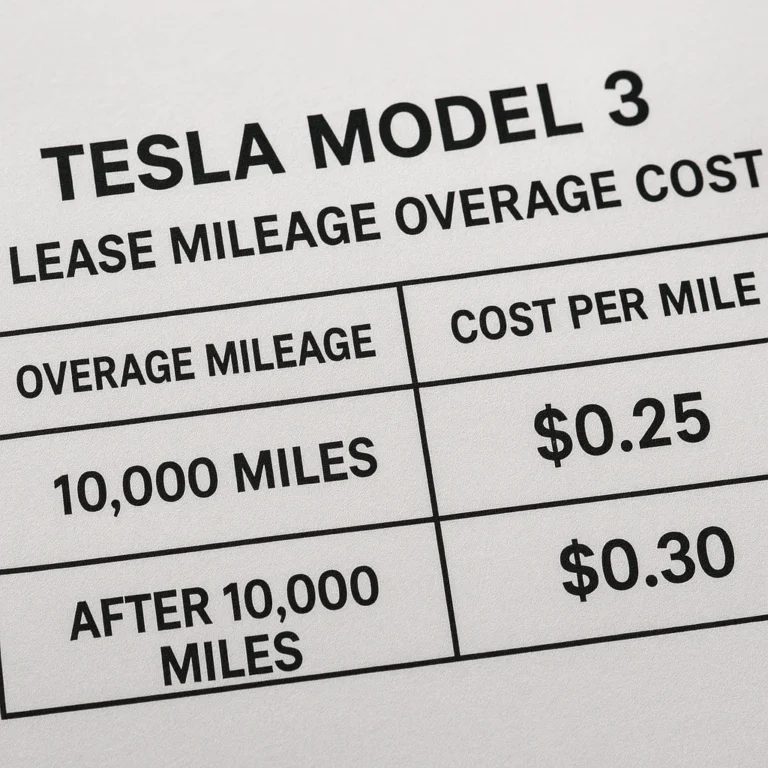
Real-World Example: The Tesla Model 3
Let’s look at a hypothetical lease on a Tesla Model 3.
- Scenario A (10k miles/year): The residual value is set at 5% of the MSRP. Your monthly payment might be $450.
- Scenario B (15k miles/year): The residual value drops to 50% of the MSRP. Your monthly payment jumps to $520.
That’s a $70 difference per month just for driving an extra 5,0 miles a year. Over 36 months, that’s $2,520 in extra payments. Is those extra miles worth $70 a month to you?
Pro Tip: Always ask the dealer to run the numbers for different mileage tiers. Sometimes the jump from 10k to 12k is negligible, but 12k to 15k can be steep.
📉 The Math Behind the Mileage: Understanding Excess Charges
So, you’ve signed the lease. You’ve been driving. But wait… you just realized you’re taking a lot of road trips this summer. You’re going to blow past that 12,0-mile limit. What happens then?
This is where the Excess Mileage Charge kicks in. This is a fee you pay at the end of the lease for every mile you drove over your agreed limit.
The Cost Per Mile
The cost isn’t a flat fee; it’s a per-mile rate defined in your contract.
- Luxury Brands (BMW, Mercedes, Audi): Often charge $0.25 to $0.30 per excess mile.
- Mainstream Brands (Toyota, Honda, Ford): Usually charge $0.15 to $0.20 per excess mile.
- Electric Vehicles: Can vary wildly, sometimes hitting $0.25+ due to battery degradation concerns.
The “Shock” Calculation
Imagine you have a 3-year lease with a 36,0-mile limit (12k/year).
You return the car with 48,0 miles.
You are 12,0 miles over.
If your rate is $0.20/mile:
12,0 miles x $0.20 = $2,40
$2,40! That’s the price of a nice vacation or a new set of wheels. And this is why understanding the math is crucial.
Why the Rates Vary
Leasing companies set these rates based on the depreciation curve of the specific vehicle. If a car loses value rapidly with high mileage, the penalty is higher. If a car holds its value well (like a Toyota Tacoma or a Jep Wrangler), the penalty might be lower, but the initial lease payment might be higher due to a higher residual value.
🛣️ Choosing the Right Mileage Tier: 10k vs. 12k vs. 15k
Choosing your mileage tier is like picking the right size of a pizza. If you pick too small, you’re hungry (and paying extra). If you pick too big, you’re wasting money on crust you won’t eat.
The Standard Tiers Explained
| Tier | Annual Miles | Total (3 Years) | Best For… | Risk Factor |
|---|---|---|---|---|
| 10,0 | 10k | 30k | City dwellers, short commutes, second cars | High (Easy to exceed) |
| 12,0 | 12k | 36k | Average commuters, occasional road trips | Medium (The “Safe” Bet) |
| 15,0 | 15k | 45k | Long commutes, frequent travelers, gig workers | Low (Hard to exceed) |
How to Calculate Your Needs
Don’t guess! Look at your past driving habits.
- Check your odometer at the start of the year.
- Check it again in a year.
- Add 10-15% to that number for “life happens” (moving, new job, road trips).
We’ve seen too many clients choose 10,0 miles because it looked cheaper, only to end up paying $3,0 in overage fees. It’s almost always better to pay a few dollars more upfront for a higher mileage cap than to face the penalty at the end.
Wait, is there a middle ground? What if you need 13,0 miles? Most dealers can customize the cap, but it will cost you. We’ll get to that in the next section.
🚫 What Happens If You Go Over? The Shocking Truth About Overage Fees
We’ve talked about the math, but let’s talk about the reality of returning a car with too many miles.
When you turn in your leased vehicle, the dealer will inspect it. They will check the tires, the paint, the interior, and the odometer. If you are over the limit, they will calculate the fee and add it to your final bill.
The “Surprise” Bill
Many people are shocked when they see this bill. They thought, “I’ll just drive less next year.” But the lease is a closed contract. You can’t “make up” for it by driving less in the final month.
The fee is non-negotiable once the contract is signed, unless you take action before the lease ends.
The Hidden Costs
It’s not just the mileage fee. High mileage can also trigger:
- Excessive Wear and Tear: A car with 60,0 miles is more likely to have worn tires, brake pads, and suspension issues. You might be charged for these repairs in addition to the mileage fee.
- Warranty Voidance: If you exceed the manufacturer’s warranty mileage (e.g., 36,0 miles on a 3-year lease), you might be responsible for repairs that would otherwise be covered.
🛠️ Can You Buy More Miles? Mid-Lease Mileage Adjustments
Here is the good news: You are not doomed if you realize you’re going to go over. You can buy more miles during the lease term.
How It Works
Most leasing companies allow you to purchase additional mileage in blocks (usually 1,0, 3,0, or 5,0 miles) before the lease ends.
- Cost: The cost per mile for pre-purchasing is usually lower than the penalty rate.
Example: Penalty rate = $0.25/mile. Pre-purchase rate = $0.15/mile. - Timing: You can do this at any time, but it’s best to do it early to avoid the surprise bill.
The Strategy
If you realize in Year 2 that you’re going to exceed your limit by 5,0 miles, call your leasing company. Ask to purchase 5,0 additional miles.
- Cost: 5,0 x $0.15 = $750.
- Savings: If you waited, you’d pay 5,0 x $0.25 = $1,250.
- Total Savings: $50.
Note: Not all leases allow this. Some “closed-end” leases are rigid. Always check your contract or call the lessor (e.g., BMW Financial Services, Toyota Financial Services) to confirm.
🔄 Trading In Early: How Mileage Affects Your Turn-In Value
What if you can’t wait until the end of the lease? What if you need to trade in early?
The Early Termination Penalty
If you terminate a lease early, you are usually responsible for the remaining depreciation plus a termination fee. High mileage makes this even worse because the car is worth less than the residual value.
The “Sell It Yourself” Hack
This is where the auto hack from the video summary comes in. If you are over your mileage limit, do not just turn the car in.
- Check the Market Value: Use sites like Keley Blue Book (KBB) or Edmunds to see what your car is worth with the high mileage.
- Compare to Residual Value: If the market value is close to or higher than your residual value, you can sell the car privately or trade it in at a dealership.
- The Math:
- Overage fee: $2,50 (10k miles over at $0.25).
- Market value is $1,0 below residual.
- If you sell privately, you might only lose $1,0 instead of paying $2,50 in fees.
This is a game-changer. It turns a “penalty” into a “market adjustment.”
🛡️ Protecting Your Wallet: Strategies to Avoid Mileage Penalties
You don’t have to be a victim of the mileage trap. Here are our top strategies to keep your wallet safe.
1. Be Conservative with Your Estimate
As the video suggested, be a little conservative. If you think you’ll drive 18,0 miles, lease for 20,0. It’s better to have a few miles left over (which you can’t get a refund for, but you won’t pay for) than to owe thousands.
2. Monitor Your Odometer
Don’t wait until the end of the lease. Check your mileage every 6 months. If you’re trending high, buy more miles now.
3. Consider a “High Mileage” Lease
Some manufacturers offer specific leases with 20,0 or 25,0 miles per year. These are rare but exist for people who drive a lot.
4. The “Lease Hack” of Selling
If you’re going to go over, sell the car before the lease ends. This is often the most cost-effective solution.
5. Negotiate the Rate
Believe it or not, some dealers can negotiate the excess mileage rate at the time of signing. It’s not common, but it doesn’t hurt to ask.
🆚 Lease vs. Buy: Does High Mileage Make Ownership a Better Deal?
If you drive a lot, is leasing even the right choice?
The Lease Argument
Leasing is great for low mileage. You get a new car every 3 years, and you never have to worry about selling a high-mileage car. But if you drive 20,0+ miles a year, the excess fees can make leasing more expensive than buying.
The Buy Argument
When you buy a car, you own it. You can drive 10,0 miles if you want. You don’t pay a penalty. The only cost is the depreciation, which you absorb as the owner.
The Break-Even Point
For most drivers, if you exceed 15,0 miles per year, buying might be the better financial move. The cost of leasing extra miles often exceeds the cost of owning a car with high mileage.
📊 Real-World Scenarios: Commuters, Road Trippers, and Gig Drivers
Let’s look at how different drivers are affected.
The Daily Commuter
- Scenario: 20 miles round trip, 5 days a week.
- Mileage: ~5,20 miles/year.
- Verdict: A 10,0-mile lease is perfect. You’ll have miles left over.
The Road Tripper
- Scenario: 20 miles commute + 2 long trips (1,0 miles each) per year.
- Mileage: ~15,0 miles/year.
- Verdict: A 15,0-mile lease is essential. 12k will leave you in the red.
The Gig Driver (Uber/Lyft)
- Scenario: Driving for a living.
- Mileage: 30,0+ miles/year.
- Verdict: Do not lease. Most leases prohibit commercial use. If you do lease, you will be hit with massive fees and potential contract violations. Buying is the only viable option.
🧐 Common Myths About Car Lease Mileage Debunked
Let’s clear up some confusion.
Myth 1: “I can return the car early if I go over.”
False. Returning the car early doesn’t waive the mileage fee. You still owe for the miles you drove.
Myth 2: “I can just drive less in the last month to make up for it.”
False. The lease is based on the total miles at the end of the term. You can’t “undo” miles you’ve already driven.
Myth 3: “All brands charge the same for excess miles.”
False. BMW and Mercedes often charge more than Toyota and Honda. Always check the contract.
Myth 4: “I can negotiate the mileage limit after signing.”
False. You can buy more miles, but you can’t reduce the limit or change the terms of the contract once signed.
✅ Quick Tips and Facts (Recap)
Just to make sure you’ve got it all straight:
- Pre-purchase miles if you think you’ll go over.
- Sell the car if the overage fee is too high.
- Check your contract for the specific penalty rate.
- Don’t guess your mileage; calculate it.
- Consider buying if you drive more than 15k miles a year.
For more tips on getting the best deals, visit our Latest Car Lease Deals page.
🏁 Conclusion

Navigating the world of car lease mileage doesn’t have to be a nightmare. By understanding how mileage limits affect your monthly payments and end-of-lease fees, you can make informed decisions that save you thousands of dollars.
Our Top Recommendation:
If you’re unsure about your mileage needs, err on the side of caution. It’s better to pay a little extra upfront for a higher mileage cap than to face a massive bill at the end of the lease. And if you do find yourself over the limit, remember the sell-it-yourself hack—it could save you a fortune.
Whether you’re a city slicker or a road trip enthusiast, the key is planning. Don’t let the odometer catch you off guard.
🔗 Recommended Links
- 👉 Shop New Cars: Toyota Official Website | Honda Official Website | BMW Official Website
- Compare Lease Deals: Edmunds Lease Calculator | TrueCar Lease Deals
- Check Your Credit Score: Credit Score and Car Leasing Guide
❓ FAQ

How does mileage impact monthly car lease payments?
Mileage directly impacts the residual value of the car. A higher mileage cap means a lower residual value, which increases the depreciation you pay over the lease term, resulting in higher monthly payments.
Read more about “🧮 How Is the Monthly Payment on a Car Lease Calculated? (2026)”
What tips can help me avoid mileage penalties on a car lease?
- Pre-purchase additional miles during the lease term.
- Monitor your odometer regularly.
- Sell the car privately if the overage fee is higher than the difference between market value and residual value.
- Choose a higher mileage cap at the start if you anticipate high usage.
Read more about “Closed vs. Open Lease: The $10k Mistake to Avoid (2026) 🚗💸”
How does mileage affect the residual value of a leased car?
Mileage is a primary factor in determining residual value. The more miles a car has, the less it is worth at the end of the lease. Leasing companies use standardized depreciation curves based on mileage to set these values.
Read more about “🚗 Yes, You Can Escape Your Car Lease Early (7 Ways to Do It)”
Are there lease options with unlimited mileage?
No. Most standard leases have a fixed mileage cap. However, some manufacturers offer high-mileage leases (e.g., 20,0 or 25,0 miles per year) for an additional cost.
Read more about “🚗 0% Car Loans: The Real Credit Score You Need (2026)”
What happens if I exceed my lease mileage allowance?
You will be charged an excess mileage fee at the end of the lease. This fee is typically $0.15 to $0.30 per mile over the limit, depending on the manufacturer and your contract.
Read more about “🚗 How Mileage Affects Your Lease Payments: The 2026 Guide”
Can I negotiate mileage limits when leasing a car?
You cannot change the mileage limit after signing, but you can negotiate the cap before signing. You can also purchase additional miles during the lease term, often at a discounted rate compared to the penalty.
Read more about “🚨 7 Hidden Fees That Will Ruin Your Car Lease (2026)”
How do excess miles impact the cost of a car lease?
Excess miles add a significant cost to the total cost of the lease. For example, 10,0 excess miles at $0.20/mile adds $2,0 to your final bill.
Read more about “🚗 Can You Lease a Car with a 580 Credit Score? (2026)”
What is the average mileage allowance on a car lease?
The most common allowances are 10,0, 12,0, and 15,0 miles per year.
Read more about “🚨 Tesla Model Y Lease Price: Is That $578 Deal a Trap or a Steal? (2026)”
Can I purchase additional mileage on a car lease if I need it?
Yes. Most leasing companies allow you to purchase additional miles in blocks (e.g., 1,0, 3,0, 5,0) at a rate lower than the penalty fee.
Read more about “🚀 10 Best Tesla Lease Deals for 2026: Save Big Today”
What are the pros and cons of a high-mileage car lease?
- Pros: No worry about overage fees, flexibility for long commutes.
- Cons: Higher monthly payments, potentially lower residual value.
Read more about “🚗 Lease Assumption Requirements: The 2026 Guide to Taking Over a Lease”
How does mileage affect the resale value of a leased car?
High mileage significantly reduces the resale value of a car. This is why leasing companies charge penalties for excess miles—they are protecting their future asset value.
Read more about “🏎️ 15+ Top Luxury Car Lease Deals for 2026: Drive Smart, Not Hard”
Can I negotiate the mileage limit on a car lease?
You can negotiate the initial mileage cap before signing. Once signed, you can only add miles, not reduce the limit.
Read more about “🚗 12 Best Car Leases for Seniors in 2026: Top Picks for Safety & Value”
How do I calculate my mileage needs for a car lease?
Track your current driving for a year, add 10-15% for unexpected trips, and choose the next available tier (10k, 12k, 15k).
Read more about “🚗 How Much is Insurance on a Leased Tesla Model 3? (2026)”
What is the average mileage allowed on a car lease?
The average is typically 12,0 miles per year, but 10,0 and 15,0 are also very common.
Read more about “🚫 Zero Down Car Lease Deals No Credit Check: The 2026 Truth”
📚 Reference Links