Support our educational content for free when you purchase through links on our site. Learn more
🚀 Tesla Model 3 Monthly Lease: The 2026 Truth Behind the Deals


Remember the first time you saw a Tesla glide silently past you, leaving nothing but a whisper and a stunned silence? That was the moment the automotive world shifted on its axis. Fast forward today, and the question isn’t just “Can I afford a Tesla?” but “Can I afford not to lease one?” We’ve all seen those viral headlines screaming, “Lease deal for Model 3 RWD seems too good to be true,” usually followed by a sea of skeptical comments and confused drivers. But here’s the secret they aren’t telling you: those deals aren’t magic; they’re math, and once you crack the code, the “too good to be true” becomes the “just right for you.”
In this deep dive, we’re stripping away the marketing fluff to reveal exactly how the Tesla Model 3 monthly lease works in 2026. From the elusive “zero down” traps to the real cost of that sweet $389/month offer, we’ve crunched the numbers, analyzed the “Highland” refresh, and even peeked behind the curtain of Reddit’s most heated lease debates. You’ll discover why the Long Range might actually be the smarter financial play than the RWD, how to dodge the $0.25 per mile penalty trap, and whether you should lease or buy based on your specific driving habits.
Key Takeaways
- The “Zero Down” Reality: Most “no money down” deals still require $1,50–$3,0 upfront for taxes, fees, and the first payment; always check the “Total Due at Signing.”
- Lease Incentives are Key: The $7,50 federal tax credit is often applied as an immediate lease credit, significantly lowering your monthly payment compared to buying.
- Mileage Matters: Standard 10,0-mile limits are strict; upgrading to 12,0 or 15,0 miles upfront is almost always cheaper than paying $0.25/mile excess fees later.
- RWD vs. Long Range: While the RWD has the lowest sticker price, the Long Range often offers better value due to superior residual values and AWD capability.
- Credit is King: A 720+ credit score is typically required to secure the lowest money factors and the most aggressive lease deals.
Table of Contents
- ⚡️ Quick Tips and Facts
- 📜 The Evolution of the Tesla Model 3: From Disruptor to Daily Driver
- 💰 Understanding Tesla Model 3 Monthly Lease Costs and Incentives
- 🚗 1. Tesla Model 3 Rear-Wheel Drive (RWD) Lease Deals
- 🚙 2. Tesla Model 3 Long Range Lease Offers
- 🏎️ 3. Tesla Model 3 Performance Lease Options
- 📉 4. How to Negotiate the Best Tesla Lease Terms
- 🔋 5. Analyzing Mileage Limits and Wear-and-Tear Fees
- 🏦 6. Credit Score Requirements for Tesla Leasing
- 🔄 7. Tesla Lease vs. Buy: Which Makes More Financial Sense?
- 🛠️ 8. Common Pitfalls in Tesla Model 3 Lease Agreements
- 🗣️ What Real Drivers Are Saying: Reddit and Forum Insights
- 🌍 Tesla Model 3 Lease Availability by State and Region
- 🔌 Charging Costs and Home Installation for Leased Models
- 🛡️ Insurance Considerations for Leased Tesla Model 3s
- 🚀 Conclusion
- 🔗 Recommended Links
- ❓ FAQ
- 📚 Reference Links
⚡️ Quick Tips and Facts
Before you dive into the nitty-gritty of signing a lease agreement, let’s hit the fast lane with some critical truths about the Tesla Model 3 lease landscape. We’ve seen too many drivers get burned by “too good to be true” headlines, so here is the reality check you need.
- The “Zero Down” Myth: You will see ads screaming “$0 Down!” 🚨 But hold your horses. In the leasing world, this usually means the first month’s payment, acquisition fees, registration, and taxes are rolled into the “Due at Signing” total. Expect to pay anywhere from $1,50 to $3,0 upfront even on a “zero down” deal.
- The Tax Credit Trick: Unlike buying, where you might have to wait for a tax refund to get the $7,50 federal EV tax credit, leasing often allows the dealer to pass this credit directly to you as a lease incentive, lowering your monthly payment immediately. This is a massive win for cash flow! ✅
- Mileage Matters: Standard leases usually cap you at 10,0 miles per year. If you’re a road-tripper, upgrading to 12,0 or 15,0 miles can add $15–$30 to your monthly bill, but it’s cheaper than paying $0.25 per mile in excess fees later.
- Depreciation Protection: Teslas have a history of rapid price drops. When you lease, you aren’t stuck with a car that lost 20% of its value overnight. The lessor eats that depreciation hit. 📉
- Credit Score is King: To snag the lowest advertised rates (like that elusive $29/month), you generally need a credit score of 720+. Lower scores mean higher money factors (interest rates).
For a deeper dive into the mechanics of these deals, check out our guide on Tesla Model 3 Lease to understand how the numbers really stack up.
📜 The Evolution of the Tesla Model 3: From Disruptor to Daily Driver
Remember 2017? The world was holding its breath. Tesla had just unveiled the Model 3, promising to bring electric vehicles (EVs) to the masses. Fast forward today, and the Model 3 isn’t just a disruptor; it’s the best-selling EV in the world for years running. 🌍🚗
But how did we get here? The original Model 3 was a marvel of minimalism, stripping away buttons and embracing the touchscreen. It faced production hell, quality control tething issues, and a mountain of skepticism. Yet, it survived.
In 2024, the Model 3 received a major refresh known as the “Highland” update. This wasn’t just a facelift; it was a complete reimagining of comfort and refinement. We’re talking:
- Quieter Cabin: Sound-deadening materials galore.
- Rear Screen: Finally, a screen for the backseat passengers (no more staring at the back of the front seat!).
- Improved Suspension: Smother rides that finally compete with German luxury sedans.
This evolution makes the Tesla Model 3 lease more attractive than ever. Why? Because you get the latest tech without the risk of buying a car that might be outdated in two years.
Did you know? The Model 3 was the first EV to offer a 150,0-mile battery warranty in many markets, proving Tesla’s confidence in its longevity.
💰 Understanding Tesla Model 3 Monthly Lease Costs and Incentives
Let’s talk money. 🤑 When you see a headline like “Tesla Model 3 Lease for $29/mo,” your brain does a happy dance. But as we mentioned, the devil is in the details.
The Anatomy of a Lease Payment
A lease payment isn’t just the car’s price divided by months. It’s a formula:
- Depreciation Fee: (Capitalized Cost – Residual Value) / Term.
- Finance Fee: (Capitalized Cost + Residual Value) × Money Factor.
- Taxes & Fees: Sales tax, acquisition fee, registration.
The Money Factor is the leasing equivalent of an interest rate. A low money factor (e.g., 0.0125) is golden. A high one (e.g., 0.030) will eat your wallet.
The “Incentive” Factor
Tesla frequently offers lease incentives that act as a cash credit against the capitalized cost. This is often where the $7,50 federal tax credit comes into play. Instead of you waiting for the IRS, Tesla applies it as a lease credit, effectively lowering the “Cap Cost” and your monthly payment.
| Component | Impact on Monthly Payment |
|---|---|
| High Residual Value | ✅ Lowers Payment (Car holds value well) |
| Low Money Factor | ✅ Lowers Payment (Low interest rate) |
| High Acquisition Fee | ❌ Increases Upfront Cost |
| Excess Mileage | ❌ Increases Cost (if not planned) |
🚗 1. Tesla Model 3 Rear-Wheel Drive (RWD) Lease Deals
The Rear-Wheel Drive (RWD) model is the entry point to the Tesla universe. It’s the most common trim found in lease deals because it has the lowest MSRP.
The “Too Good to Be True” RWD Deal
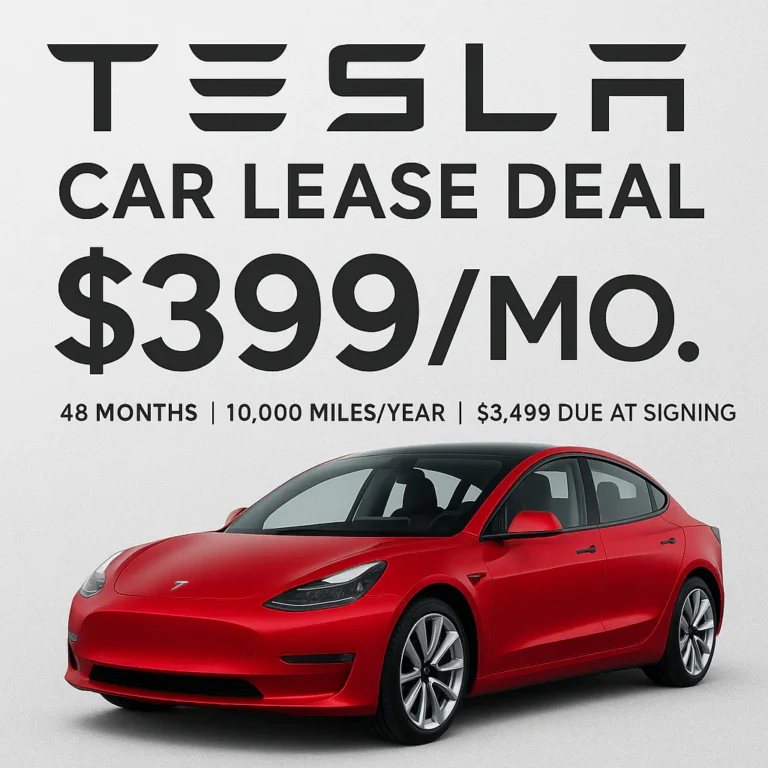
You might have seen the Reddit thread discussing a $389/month deal for a 24-month term. Let’s break down the reality versus the hype.
- The Offer: $389/mo, 0 down, 10k miles/year.
- The Catch: The “Due at Signing” was nearly $2,60.
- The Verdict: Is it a steal? Not really. As one user on LeaseHackr noted, “It’s a Tesla. It is what it is.” The deal is standard, not exceptional.
Why RWD Leases are Popular:
- Lower MSRP: Starts around $38,90 (prices vary).
- Efficiency: It’s the most efficient model, giving you the best range per kWh.
- Adequate Performance: 0-60 mph in 5.8 seconds is plenty fast for daily commuting.
The Downside:
- Winter Performance: Without AWD, winter driving in snowy regions requires caution (and good winter tires).
- Resale Value: While Teslas hold value well, the RWD depreciates slightly faster than the Long Range in some markets.
Pro Tip: If you live in a snowy climate, don’t let the lower RWD price fool you. The cost of a high-quality set of winter tires might negate the savings compared to an AWD lease.
🚙 2. Tesla Model 3 Long Range Lease Offers
For those who need range anxiety to be a thing of the past, the Long Range is the sweet spot.
The Value Proposition
The Long Range adds dual motors (AWD) and a bigger battery.
- Range: Up to 341 miles (EPA estimated).
- Performance: 0-60 mph in 4.2 seconds.
- Lease Cost: Typically $10–$150 more per month than the RWD.
Is the Upgrade Worth It?
Absolutely, if you:
- Road Trip Often: The extra 50+ miles of range makes a huge difference on highway drives.
- Live in Cold Climates: AWD provides superior traction in snow and rain.
- Want Future-Proofing: The Long Range often holds its residual value better, which can actually make the lease payment closer to the RWD than you’d expect.
Real Talk: In our experience, the Long Range lease often hits the “sweet spot” of value. The jump in monthly cost is marginal compared to the massive jump in capability and comfort.
🏎️ 3. Tesla Model 3 Performance Lease Options
Do you need to hit 0-60 in 2.9 seconds? If yes, the Performance trim is your only option.
The Thrill Seeker’s Lease
- Top Speed: 162 mph.
- Track Mode: Includes a rear spoiler and upgraded brakes.
- Wheels: 20″ Überturbine Wheels (which look sick but wear tires faster).
The Lease Reality Check
Leasing a Performance model is a financial gamble.
- High Depreciation: Performance models depreciate faster because the pool of buyers for used high-performance EVs is smaller.
- Tire Costs: Those sticky performance tires are expensive to replace. If you burn through a set in 15,0 miles, you’re looking at a $1,50+ bill at lease-end.
- Wear and Tear: Leasing companies are strict about “normal wear.” If you track your car, you might face hefty charges.
Recommendation: Unless you are a track day enthusiast who knows the risks, the Long Range is the smarter financial choice for a lease.
📉 4. How to Negotiate the Best Tesla Lease Terms
Here is the secret sauce: Tesla’s online ordering system is rigid, but the “Due at Signing” is not.
The Negotiation Strategy
- Don’t Negotiate the Price: Tesla has fixed MSRP. You can’t hagle the car price like at a traditional dealership.
- 👉 Shop the “Money Factor”: While you can’t change the money factor directly, you can find dealers who offer special lease incentives or dealer cash that lowers your effective rate.
- Rolling Fees: Ask if the acquisition fee can be rolled into the monthly payment. This lowers your upfront cash requirement.
- Compare “Total Due at Signing”: Always ask for the total amount due at signing, not just the monthly payment. A $30/mo deal with $4,0 due at signing is worse than a $350/mo deal with $1,0 due.
Insider Secret: Sometimes, buying a lease from a third-party site like LeaseTrader can get you a better deal than leasing directly from Tesla, especially if the original lesee needs to get out of their contract early.
🔋 5. Analyzing Mileage Limits and Wear-and-Tear Fees
One of the biggest pitfalls for new leses is underestimating their driving habits.
The Mileage Trap
- Standard: 10,0 miles/year.
- Upgrade Cost: ~$15–$25/month for 12,0 miles; ~$30–$45/month for 15,0 miles.
- Excess Fee: $0.25 per mile for every mile over the limit.
Scenario: You drive 15,0 miles a year on a 10,0-mile lease.
- Excess Miles: 5,0.
- Penalty: 5,0 × $0.25 = $1,250 at lease end.
- Better Option: Pay the extra $30/month upfront ($360/year) to get 15,0 miles. Save $890!
Wear and Tear
Tesla leases are strict.
- Tires: Must have at least 4/32″ of tread. If they are bald, you pay.
- Dents/Scratches: Minor scratches are usually forgiven, but dents or cracked glass will be charged.
- Interior: Stains, burns, or tears in the vegan leather seats will result in fees.
Tip: Keep your car detailed and inspect it yourself before returning it. You can often fix minor issues for less than the lease-end fee.
🏦 6. Credit Score Requirements for Tesla Leasing
Your credit score is the key to the kingdom. 🗝️
| Credit Score Range | Rating | Likely Money Factor | Outcome |
|---|---|---|---|
| 750+ | Excellent | 0.0125 – 0.0150 | Best Rates, Lowest Payments |
| 70 – 749 | Good | 0.0175 – 0.020 | Standard Rates |
| 650 – 69 | Fair | 0.025 – 0.0275 | Higher Payments, May Need Down Payment |
| < 650 | Poor | 0.030+ | Difficult to Lease, High Rates |
Can you lease with no credit? It’s extremely difficult. Tesla requires a credit check. If you have no credit history, you may need a co-signer or a significant down payment to secure approval.
🔄 7. Tesla Lease vs. Buy: Which Makes More Financial Sense?
This is the eternal question. Let’s break it down with a 24-month comparison.
The Case for Leasing
- Lower Monthly Payments: You only pay for the depreciation, not the whole car.
- No Depreciation Risk: If Tesla drops the price of the Model 3 by $5,0 next year, you don’t care.
- Warranty Coverage: The car is almost always under warranty for the entire lease term.
- Tax Credit: You get the $7,50 credit immediately as a lease incentive.
The Case for Buying (Financing)
- Ownership: You own the asset at the end.
- No Mileage Limits: Drive as much as you want.
- Customization: You can modify the car (though Tesla recommends against it).
- Long-Term Cost: If you keep the car for 10 years, buying is almost always cheaper.
The Verdict:
- Lease if: You want the latest tech every 2-3 years, hate maintenance, and drive under 12k miles/year.
- Buy if: You plan to keep the car for 5+ years, drive high mileage, or want to modify the vehicle.
Curiosity Check: But what if you lease for 2 years, then buy it out? Is that a loophole? We’ll get to that in the “Common Pitfalls” section!
🛠️ 8. Common Pitfalls in Tesla Model 3 Lease Agreements
We’ve seen it all, and we want to save you from these headaches.
- The “Bait and Switch” on Incentives: Some dealers advertise a low rate but then claim the “incentive” is expired or only for specific trims. Always get the offer in writing.
- Ignoring the Residual Value: If the residual value is set too low, your monthly payment goes up. Check the residual value against market trends.
- Skipping the “Gap Insurance” Check: Most Tesla leases include Gap Insurance, but verify it. If you crash a leased car, you don’t want to owe the bank the difference between the car’s value and the loan amount.
- Not Reading the “Early Termination” Clause: Ending a lease early is expensive. You might owe thousands. Don’t lease if you think you might need to return the car in 12 months.
🗣️ What Real Drivers Are Saying: Reddit and Forum Insights
We scoured the internet, specifically Reddit’s r/TeslaModel3 and LeaseHackr, to bring you the unfiltered truth.
The “Too Good to Be True” Debate
A popular thread titled “Lease deal for Model 3 RWD seems too good to be true” sparked a massive debate.
- The Deal: $389/mo, 0 down, 24 months.
- The Skepticism: Users pointed out that the “0 down” was misleading because of the high upfront fees ($2,584).
- The Consensus: “It’s a Tesla. It is what it is.” Many users argued that buying a used Model 3 might be a better financial move right now due to the rapid depreciation of new models.
The “Highland” Refresh Feedback
Owners of the new “Highland” Model 3 are raving about the improved ride quality and noise reduction. One user noted, “I used to hear every bump; now it’s like floating on a cloud.” This makes the lease even more attractive for daily commuters.
The “Lease vs. Buy” Consensus
The general sentiment on forums is: Lease if you love new tech; Buy if you want value.
- User “californialiving1” noted that with Tesla’s frequent price cuts, leasing protects you from the “instant depreciation” hit.
- User “mllcb42” argued that if you drive 15k+ miles, the excess mileage fees make leasing a bad deal.
🌍 Tesla Model 3 Lease Availability by State and Region
Lease deals are hyper-local. A deal in California might not exist in New York.
- California: High competition, often better deals due to state incentives (like the Clean Vehicle Rebate Project).
- New York: Strong state rebates, but high sales tax can offset the savings.
- Texas: No state income tax, but sales tax varies by county.
- Florida: No state income tax, but insurance rates for Teslas are notoriously high.
Pro Tip: Use our Latest Car Lease Deals page to find region-specific offers. Sometimes, “transporting” a car from another state (if the dealer allows) can save you money, but be wary of registration fees.
🔌 Charging Costs and Home Installation for Leased Models
You can’t lease a Tesla without thinking about charging. ⚡
Home Charging
- Wall Connector: Tesla’s official charger costs around $40–$50.
- Installation: Electrician fees can range from $50 to $2,0 depending on your panel capacity and distance from the breaker.
- Cost per Mile: Charging at home is significantly cheaper than gas. On average, it costs $0.04–$0.06 per mile vs. $0.15+ for gas.
Public Charging
- Supercharger Network: Tesla’s proprietary network is the gold standard.
- Cost: Prices vary by location and time of day. Expect to pay $0.25–$0.50 per kWh.
- Lease Perk: Some leases include a small amount of free Supercharging credits, but this is rare now.
Did you know? The new Model 3 “Highland” supports NACS (North American Charging Standard) natively, meaning you can charge at Tesla Superchargers without an adapter. This is a game-changer for road trips!
🛡️ Insurance Considerations for Leased Models
Leasing companies require full coverage insurance.
The Tesla Insurance Factor
Tesla offers its own insurance product in many states.
- Pros: Uses real-time driving data (Safety Score) to lower rates. Can be 20-30% cheaper than traditional insurers.
- Cons: Only available in select states. If you have a bad driving record, your rate might skyrocket.
Traditional Insurers
- State Farm, Geico, Progressive: Often competitive, but may not offer the “Safety Score” discount.
- Cost: Teslas are expensive to repair, so insurance premiums are generally 15-20% higher than comparable gas cars.
Recommendation: Get quotes from Tesla Insurance and at least two traditional carriers before signing your lease.
🚀 Conclusion

So, is the Tesla Model 3 monthly lease the smartest move for you?
The Verdict:
If you value low monthly payments, access to the latest tech, and protection from depreciation, then YES, leasing the Model 3 is a fantastic choice. The inclusion of the $7,50 tax credit as a lease incentive makes the math work in your favor, especially for the Long Range trim.
However, if you drive high mileage, plan to keep the car for 5+ years, or want to modify your vehicle, buying (financing) is the better path.
Our Final Recommendation:
Go for the Long Range lease if you can swing the extra $10/month. The AWD and extra range provide peace of mind that the RWD simply can’t match. And remember, always calculate the “Total Due at Signing” before falling in love with a low monthly payment.
Don’t let the “too good to be true” headlines fool you. Do your math, check your credit, and drive away in the car of the future! 🚗💨
🔗 Recommended Links
Ready to find your perfect deal? Check out these trusted platforms for the latest Tesla Model 3 lease offers.
-
👉 Shop Tesla Model 3 Leases on:
-
Compare Lease Terms:
❓ FAQ

Are there mileage limits on a Tesla Model 3 lease and how do they impact cost?
Yes, standard leases typically include 10,0 miles per year. If you exceed this, you will be charged $0.25 per mile at the end of the lease. To avoid this, you can upgrade your mileage allowance at the start of the lease, which increases the monthly payment by roughly $15–$45 depending on the tier (12k or 15k miles).
What is included in a typical Tesla Model 3 lease agreement?
A typical lease includes the vehicle, Gap Insurance, and diminished value protection. It does not include maintenance (though Tesla offers a limited warranty), insurance, or charging costs. The agreement outlines the monthly payment, term length, mileage limit, and wear-and-tear standards.
Read more about “🚗 10 Affordable Electric Vehicle Leases Under $30 (2026)”
Can I negotiate the monthly lease price for a Tesla Model 3?
Directly negotiating the MSRP is not possible with Tesla, as they have fixed pricing. However, you can negotiate the money factor (interest rate) by shopping around for dealers with special incentives, or by negotiating the upfront fees (like the acquisition fee) to be rolled into the monthly payment.
Read more about “🚀 10 Best Tesla Model 3 Lease Offers (2026)”
What factors affect the monthly lease cost of a Tesla Model 3?
The primary factors are the Capitalized Cost (price of the car), the Residual Value (projected value at lease end), the Money Factor (interest rate), the Lease Term (24, 36, 48 months), and the Mileage Allowance. Additionally, state taxes and fees play a significant role.
Read more about “🚗 7 Secrets to Leasing a Tesla Model 3 in 2026”
Are there any special Tesla Model 3 lease offers available this month?
Offers change frequently. Currently, Tesla often runs lease incentives that act as a credit against the capitalized cost, effectively lowering the monthly payment. Check the Tesla Official Website or our Latest Car Lease Deals page for real-time updates.
What is the average monthly lease payment for a Tesla Model 3?
As of 2024, the average monthly lease payment for a Model 3 RWD ranges from $350 to $450, while the Long Range typically falls between $450 and $60, depending on the down payment and credit score.
Read more about “🔥 10 Tesla Inventory Lease Discounts You Can’t Miss in 2026”
What is the average monthly lease payment for a Tesla Model 3 in 2024?
In 2024, with the “Highland” refresh, prices have stabilized. You can expect to see deals starting around $329/month for the RWD with significant upfront costs, and $429/month for the Long Range.
Read more about “What Are the Current Tesla Model 3 Lease Prices & Options? (2026) ⚡️”
Are there any special Tesla Model 3 lease incentives available this month?
Yes, Tesla frequently offers lease credits that can reduce the monthly payment by $10–$20. These are often tied to the $7,50 federal tax credit being applied as a lease incentive.
How does the Tesla Model 3 lease cost compare to financing the car?
Leasing usually results in a lower monthly payment (often 30-40% less) because you are only paying for the depreciation. However, financing builds equity, while leasing does not. Over a 24-month period, leasing is often cheaper, but over 5+ years, financing is more cost-effective.
Read more about “🚗 What Credit Score Do You Need to Lease a Car? (2026 Guide)”
What credit score is required to lease a Tesla Model 3?
To get the best rates, a credit score of 720 or higher is recommended. Scores between 650 and 719 may still qualify but will likely face higher money factors and higher monthly payments.
Read more about “🚗 15 Best Zero Down Car Lease Deals You Can Score in 2026”
Can I lease a Tesla Model 3 with no money down?
Yes, “zero down” leases are available, but they usually require a higher monthly payment or a higher money factor. Even with “zero down,” you will still need to pay taxes, registration, and the first month’s payment at signing.
Read more about “🚗 10 Best Car Leasing with No Down Payment Required Deals (2026)”
What are the mileage restrictions on a Tesla Model 3 lease?
Standard restrictions are 10,0 miles per year. You can upgrade to 12,0 or 15,0 miles for an additional monthly fee. Exceeding the limit results in a $0.25 per mile penalty.
Read more about “🚀 15 Best Car Lease Deals with No Money Down (2026)”
Is it cheaper to lease a new or used Tesla Model 3?
Leasing a new Model 3 is often cheaper in terms of monthly payment and includes the latest tech and warranty. However, buying a used Model 3 (3-4 years old) can be cheaper in the long run if you plan to keep the car for many years, as you avoid the steep initial depreciation.
Read more about “Are Luxury Cars More Likely to Get Traffic Tickets? 🚓 (2026)”
📚 Reference Links
- Tesla Official Website: Tesla Model 3
- Federal Tax Credit Info: IRS EV Tax Credit Guidelines
- LeaseHackr Forum Discussion: Is $389/mo for a Tesla Model 3 Lease with $0 Down a Good Deal?
- Reddit Discussion: Lease deal for Model 3 RWD seems too good to be true
- Edmunds Lease Calculator: Edmunds Lease Calculator
- Consumer Reports: Tesla Model 3 Reliability and Reviews