Support our educational content for free when you purchase through links on our site. Learn more
Can You Buy Your Leased Car? Find Out Fast 🔍

To find out if your leased car is available for purchase after the lease expires, check your lease agreement for a purchase option, then ask your leasing company for a written buyout quote. The lessor—not a dealership’s guess or a forum post—can confirm who is allowed to buy the vehicle and what steps you’ll need to follow.
The catch is that a residual value in your contract may not be the complete amount due. Taxes, title costs, fees, and lender rules can change the picture, so start checking several months before the lease ends.
We’ve seen drivers assume their dealer could arrange a buyout, only to discover their finance company had specific rules about who could purchase the car. A quick call to the lessor early on can save a frantic hunt for answers when the return deadline is looming.
Key Takeaways
- Read your lease agreement and look for a “purchase option” or “option to purchase.”
- Contact the leasing company directly to confirm buyout eligibility, deadlines, and who may purchase the car.
- Request an itemized written quote that explains the purchase amount, taxes, fees, and title requirements.
- Compare the all-in buyout cost with the car’s current market value and factor in condition, maintenance, warranty, and financing.
- Start several months before lease-end. Third-party buyouts and dealer requirements vary by lender and contract.
Table of Contents
- ⚡️ Quick Tips and Facts
- 🚗 How Lease-End Purchase Options Work
- What a lease buyout means
- Why availability depends on your lease and lender
- 🔎 How to Find Out If Your Leased Car Is Available to Buy
- Check your lease agreement for a purchase option
- Contact the leasing company or finance provider
- Ask your dealership about lease-end buyout rules
- Questions to ask before your lease expires
- 📝 Your Lease-End Purchase Options
- 1. Buy the car yourself
- 2. Buy the car through a dealership
- 3. Have someone else purchase the vehicle
- 4. Return the car and walk away
- 💰 What Your Lease Buyout Price Includes
- Residual value and purchase-option price
- Taxes, title, registration, and other fees
- Grounded buyout quote versus market value
- 📊 Is Buying Your Leased Car a Good Deal?
- Compare the buyout price with current vehicle value
- Factor in condition, mileage, and maintenance history
- Compare financing, cash purchase, and lease return
- 📅 When to Start Checking and What to Do Before Lease Expiration
- A lease-end timeline for your buyout decision
- Documents and vehicle details to gather
- How to request a written buyout quote
- ⚠️ Lease Buyout Restrictions, Eligibility, and Common Hurdles
- Third-party buyouts and lender policies
- Late payments, open recalls, and title requirements
- Lease extensions and missed deadlines
- 🔧 Inspection, Mileage, Wear-and-Tear, and Warranty Considerations
- 🏦 Financing a Lease Buyout
- How to shop for a buyout loan
- What lenders may need to approve financing
- ❌ Lease-End Buyout Mistakes to Avoid
- ✅ Quick Tips for a Smother Lease Buyout
- Conclusion
- 🔗 Recommended Links
- ❓ FAQ
- Can I buy my leased car if my lease agreement does not show a purchase option?
- Can I buy my leased car before the lease expires?
- Can someone else buy my leased car?
- Is the lease-end buyout price negotiable?
- Can I buy my leased car if I am over the mileage limit?
- What happens if I do not decide before my lease ends?
- 📚 Reference Links
⚡️ Quick Tips and Facts
- Start with your lease agreement. Look for “purchase option,” “option to purchase,” or “purchase option price.” The Consumer Financial Protection Bureau (CFPB) says a lease purchase option is what allows you to buy the vehicle at the end of the term.
- Ask the leasing company—not just the dealership. The finance company or lessor can confirm whether your contract allows a buyout, who may purchase the car, and what the current payoff quote is.
- Request a written, date-specific quote. A lease-end purchase price may differ from an early payoff amount, and taxes, title, registration, and processing fees may be additional.
- Check early, ideally several months before the lease ends. That gives you time to compare the buyout with the car’s market value, arrange financing, and clarify any lender restrictions.
- Do not assume mileage charges determine whether you can buy. Buying the car may avoid a lease-return mileage bill, but the buyout still has to be completed under your contract and the lender’s rules. Ask for the full figures in writing.
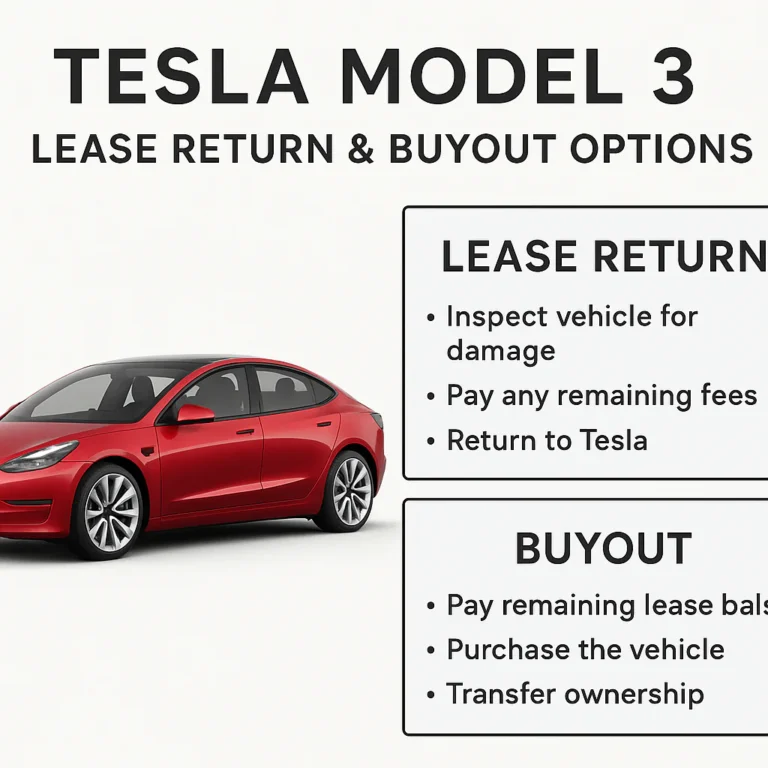
- Availability can vary by brand, lender, contract, and state. For example, some lessors restrict third-party buyouts. Tesla’s lease-end rules have also changed over time; see our related guide, Why is Model 3 not available after lease?.
- Know the key distinction: your contract’s residual value is a contractual figure, while the car’s market value is what comparable vehicles are worth now. They are not guaranteed to match.
| What to check | Where to look | Why it matters |
|---|---|---|
| Purchase-option language | Signed lease agreement and addenda | Shows whether your contract includes a right to buy |
| Lease-end purchase price | Contract and current written quote from lessor | Confirms the amount and whether it has changed or needs an update |
| Eligible buyer | Lessor or finance company | Determines whether you, a dealer, or a third party can buy it |
| Total out-the-door cost | Lessor, tax authority, DMV, or purchasing dealer | Adds taxes and transaction costs to the quoted purchase price |
| Vehicle’s market value | Comparable listings and valuation tools | Helps you judge whether buying makes financial sense |
At Car Leases™, we’d treat this as a two-call job: one call to confirm the rules, another to verify the numbers. That’s more reliable than waiting for a dealer letter—or trusting a salesperson who may be working from a different playbook.
🚗 How Lease-End Purchase Options Work
A leased vehicle is owned by the lessor, not by you. At the end of the term, you may be able to return it, buy it under a purchase option, or pursue another route allowed by your contract and the lessor. The CFPB explains that lease payments generally do not build ownership unless the lease includes a purchase option.
What a lease buyout means
A lease buyout is the purchase of the vehicle from its owner, usually the leasing company or its funding partner. At lease end, the purchase option price is often based on the residual value stated in your contract, plus any applicable taxes and fees.
A buyout is not the same as simply keeping the car after your final monthly payment. You must complete the purchase, satisfy the lessor’s requirements, and arrange the title transfer. If you finance the buyout, a bank or credit union may pay the lessor and hold a lien until the loan is repaid.
Why availability depends on your lease and lender
The answer to “Can I buy my leased car?” starts with your individual contract, not a general brand rule. Your agreement may include a purchase option, exclude one, or set conditions for exercising it. The finance company’s current policies may also determine whether a dealer or another person can purchase the vehicle.
That’s why online advice can sound contradictory. A forum commenter may say a buyout was straightforward in California, while another driver may run into a lender policy that limits third-party transactions. Both experiences can be true: contract terms, state rules, and lender procedures vary.
The CFPB’s guidance is the best starting point: check whether your lease includes a purchase option, then confirm the process with the lessor. For more on the basics, browse our Car Lease Basics guides.
🔎 How to Find Out If Your Leased Car Is Available to Buy
Here’s the practical route. First, read your contract. Then contact the company that owns or services the lease. Finally, get the terms in writing before making plans around a dealer’s offer or a guessed residual value.
Check your lease agreement for a purchase option
Find your signed lease and any amendments. Search for these terms:
- Purchase option
- Option to purchase
- Purchase-option price
- Residual value
- End-of-term purchase
- Early purchase or payoff
- Fees and conditions for exercising the option
The residual value may appear in the contract, but don’t assume it is your complete amount due. Taxes, registration, title, purchase-option fees, and other charges can apply. Also check who is permitted to exercise the option and the deadline for doing so.
The CFPB recommends reviewing lease terms before signing, including the residual value and whether a purchase option exists. Its consumer guide also explains that if the lease has no purchase option, you should not assume you can force a buyout at the stated residual.
Contact the leasing company or finance provider
Call the company listed on your statement or lease paperwork. It may be a manufacturer’s finance arm, a bank, or another leasing company. Ask for the lease-end purchase process and a current written quote.
Useful contact routes may include:
- The lessor’s official website or customer-service phone number
- Your monthly statement or online lease account
- The lease-end department listed in your contract
- A dealer, if the lessor requires dealer handling
A Leasehackr forum participant discussing a Hyundai/Genesis lease described checking the finance portal for the current buyout and said, “That’s what it will cost to purchase it today.” That is useful practical advice, but treat the amount as a quote for a specific date and transaction type, not a universal rule for every lender. Confirm directly with your own lessor.
Ask your dealership about lease-end buyout rules
A dealership may handle paperwork, inspect the vehicle, or arrange financing. But it may not be the party that sets the buyout price. Ask the dealer:
- Does the lessor require a franchised dealer to complete the purchase?
- Can I buy directly from the leasing company?
- Are you adding a dealer processing fee?
- Can you provide an itemized, written quote?
- Can I use outside financing or pay by a method other than a dealer-arranged loan?
Some consumers report that their lessor allowed a direct purchase without involving a dealer; others are told to complete the transaction through a dealer. Do not rely one driver’s location or lender as proof your own process will match.
Questions to ask before your lease expires
Use this checklist when you contact the lessor:
- Does my lease include a purchase option?
- What is the lease-end purchase price, and how long is the quote valid?
- What is the current early payoff amount, if I’m considering buying before maturity?
- Who may buy the vehicle: me, a dealer, or a third party?
- Can I buy directly, or must a dealership process the transaction?
- What taxes, title, registration, inspection, and administrative fees apply?
- What payment methods and financing sources are accepted?
- What documents and deadlines should I prepare for?
- If I buy the car, do mileage or wear charges still apply?
- Can you send the steps and amount in writing?
If you’re comparing a buyout with another lease, our guides to Best Lease Terms can help you compare the full cost instead of getting dazzled by a low monthly payment.
📝 Your Lease-End Purchase Options
Your contract and lessor determine which options are actually available. These are the common routes to ask about—not a guarantee that every lease allows each one.
1. Buy the car yourself
If your lease includes a purchase option and the lessor allows you to exercise it, you can pay cash or arrange a buyout loan. You’ll generally need to complete the lender’s purchase process and transfer title.
Potential benefits
- Keep a car whose history and condition you already know.
- Avoid shopping for another vehicle immediately.
- Potentialy avoid lease-return mileage or wear charges, subject to the contract and the lessor’s rules.
- Keep the vehicle if its market value is higher than your total buyout cost.
Potential drawbacks
- You take on future repairs and depreciation.
- The total purchase cost includes more than the residual value.
- A favorable buyout price does not automatically make an older car reliable or inexpensive to own.
2. Buy the car through a dealership
Some lessors require dealer participation; others may allow a direct purchase. A dealer could help arrange a loan, handle paperwork, or buy the vehicle and resell it to you. Ask what services are required and which charges are optional.
A dealer’s quote is not necessarily the same as the lessor’s payoff. Request an itemized breakdown so you can spot any added products, documentation charges, or financing terms you did not request.
3. Have someone else purchase the vehicle
A family member, dealer, or another buyer may be able to purchase the vehicle, but third-party buyouts are not universally permitted. Some finance companies have restricted outside purchases or changed their rules. Call the lessor and ask who may be the buyer of record before arranging a sale.
If you hope to sell the vehicle after buying it, account for the extra transaction steps, taxes, title transfer, loan payoff, and any restrictions. A possible equity gain is not guaranteed until you have verified both the purchase cost and a genuine buyer’s offer.
4. Return the car and walk away
Returning the vehicle can be the cleanest choice if the buyout is high relative to market value, you don’t want the car, or you’re ready for something different. You may still owe charges allowed by your agreement, such as excess mileage, excess wear, or a disposition fee.
The CFPB notes that leases commonly include mileage limits and may charge for excess mileage and wear at the end of the term. Review your contract and request a pre-return inspection if the lessor offers one.
💰 What Your Lease Buyout Price Includes
The number in the contract is a starting point, not always the complete amount you’ll need to complete the purchase. Get an itemized figure for the exact route you plan to use.
Residual value and purchase-option price
Residual value is the estimated value assigned to the vehicle at the end of the lease. If your agreement includes a purchase option, the residual may form the basis of the lease-end price. Your contract’s actual wording governs.
The CFPB says the residual value is what you may pay if your lease includes a purchase option. It also explains that residual value is one of the lease terms affecting payments. When arranging a new lease, the purchase option and residual assumptions are worth reviewing before you sign—not after the keys are already on your ring.
An early buyout can be calculated differently from the lease-end option. Ask for the early payoff amount rather than assuming the end-of-term residual applies today.
Taxes, title, registration, and other fees
Depending on your state and the transaction, the total may include:
- Sales or use tax
- Title and registration charges
- Lessor or purchase-option fees
- Dealer processing or documentation charges
- Inspection or emissions-related requirements
- Loan origination or lender fees, if financing
Ask the lessor and your state motor-vehicle agency what applies. The National Conference of State Legislatures provides state-level transportation information, while your state DMV or revenue department is the authority for your specific tax and title rules.
Grounded buyout quote versus market value
For a sensible comparison, put the all-in buyout cost beside the vehicle’s current market value. Compare similar year, trim, drivetrain, mileage, condition, and location—not a base model with your loaded AWD version.
| Figure | What it tells you | Where to verify |
|---|---|---|
| Contract residual | The lease’s scheduled end value | Your signed agreement |
| Current lease-end quote | The lessor’s purchase amount for the transaction | Lessor’s written quote |
| Early payoff | Amount to buy before lease maturity | Lessor’s current payoff statement |
| Market estimate | Approximate retail or trade value | Multiple valuation sources and comparable listings |
| Real purchase offer | What a buyer is actually willing to pay | Written dealer or online-buyer offer |
A credit union’s consumer article recommends comparing a buyout with current vehicle value and considering financing. That’s sound guidance, but market estimates are not guaranteed sale prices. Get at least one real offer if your plan depends on selling the car.
📊 Is Buying Your Leased Car a Good Deal?
A low residual can make a buyout attractive, but the best decision depends on more than the gap between two numbers. You know the car’s history; you may not know what its next major repair will cost.
Compare the buyout price with current vehicle value
Use this simple test:
Estimated equity = realistic vehicle value − all-in buyout cost
If the result is positive, the vehicle may have equity. If it is negative, you may be paying more than comparable vehicles are worth. Either way, this is only a snapshot: condition, taxes, transaction fees, lender rules, and the price you can actually obtain all matter.
The featured video’s perspective is that if the residual is well below the car’s market value, buying may be compelling; if you don’t want to keep the car, research its value through sources such as CarMax, Carvana, and local used-car listings. That approach can be useful, but “market value” depends on whether you’re comparing a retail asking price, trade-in estimate, or firm purchase offer. Treat each as a different measure.
Factor in condition, mileage, and maintenance history
You’ve lived with the car, which is an advantage. You know whether it has been dependable, whether it has had accident repairs, and whether routine maintenance was done. But a familiar car can still have expensive needs ahead.
Before buying, consider:
- Current tire and brake condition
- Service history and upcoming maintenance
- Accident, flood, or body-repair history
- Open safety recalls
- Remaining factory warranty and its limits
- Battery health for a plug-in hybrid or EV
- Mileage relative to comparable vehicles
- Any diagnostic warning lights or persistent issues
Check recalls through the NHTSA VIN lookup. If you lease an EV, battery condition and remaining warranty deserve particular attention; our Electric Vehicle Leases guides cover related ownership questions.
Compare financing, cash purchase, and lease return
| Choice | Best fit when… | Watch out for… |
|---|---|---|
| Pay cash | You have the funds and want to avoid an auto loan | Reduced savings liquidity and opportunity cost |
| Finance the buyout | You want to keep the car but prefer monthly payments | APR, loan term, lender eligibility, and total interest |
| Return the lease | Buyout cost or vehicle condition makes ownership unatractive | Mileage, wear, disposition, and other contract charges |
| Replace with another lease | You want a newer vehicle and predictable lease term | New upfront costs, mileage limits, and changing incentives |
Compare loan offers from banks, credit unions, and the lessor’s affiliated finance company. The CFPB’s auto-loan resources explain how to compare financing. You can also explore our Auto Financing Options and Credit Score and Car Leasing articles.
📅 When to Start Checking and What to Do Before Lease Expiration
A reminder letter may arrive, but don’t let the mailbox run your decision. Start early enough to get clear answers, compare offers, and complete paperwork without a last-week scramble.
A lease-end timeline for your buyout decision
| Timing | What to do |
|---|---|
| Several months before maturity | Find the contract, confirm the option, and ask about restrictions |
| About two to three months before maturity | Request the lease-end process and compare the car’s market value |
| Several weeks before maturity | Arrange financing or cash, confirm taxes and fees, and schedule required steps |
| Before the contract deadline | Complete the purchase or arrange a return/extension in writing |
| At handover or title transfer | Keep receipts, payoff confirmation, odometer statement, and paperwork |
Some credit-union consumer guidance suggests contacting the lessor three to six months before expiration. That’s a helpful planning window, not a universal notice schedule. A forum user’s expectation that a dealer might contact them around 90 days before return is likewise not proof every lessor sends that notice. Call the finance company yourself.
Documents and vehicle details to gather
Have these ready:
- Signed lease and any amendments
- Account number and current statement
- Vehicle identification number (VIN)
- Current odometer reading
- Registration and proof of insurance
- Maintenance and repair records
- Written buyout or payoff quote
- Financing approval, if applicable
- Any required purchase forms or power-of-attorney documents
Keep copies of everything. If someone gives you a verbal figure, ask for the amount and its expiration date in writing.
How to request a written buyout quote
Use a clear request such as:
“I’m considering exercising the purchase option on my leased vehicle. Please confirm whether my lease allows a lease-end buyout, provide the current purchase amount and an itemized list of additional fees and taxes, explain who may purchase the vehicle, and tell me the payment, title, and deadline requirements. Please send the details in writing.”
If you’re considering an early purchase, explicitly ask for an early payoff quote and the date through which it is valid. Don’t assume a lease-end quote and an early payoff are interchangeable.
⚠️ Lease Buyout Restrictions, Eligibility, and Common Hurdles
A buyout can be available in principle but still require specific steps. Get the lessor’s rules before you line up a buyer or loan.
Third-party buyouts and lender policies
Some lessors permit only the lesee or a franchised dealer to purchase the vehicle. Others may allow third-party transactions. Policies may change, and a dealer’s ability to buy a car doesn’t prove that you can sell it directly to that dealer.
Ask the lessor:
- Who can be listed as the purchaser?
- Can a dealer or family member buy it?
- Can a dealer purchase it and resell it to me?
- Does my state require a dealer to process the title?
- Are there restrictions on using an independent lender?
A forum contributor reported completing a buyout in California without a dealership, but that anecdote is not a state-wide rule. The lessor’s current instructions and your local title requirements are what to trust.
Late payments, open recalls, and title requirements
An overdue account or incomplete paperwork can delay a transaction. Before finalizing, ask whether your account must be current and whether any outstanding obligations need to be resolved.
A recall does not necessarily prevent a purchase, but it is a safety issue worth addressing. Check the VIN through NHTSA and contact an authorized dealer about repairs. Title transfer requirements differ by state; confirm them with the relevant DMV or motor-vehicle agency.
Lease extensions and missed deadlines
If you need more time, request a lease extension before the contract ends and get approval in writing. Don’t assume a payment automatically extends your right to keep the car or preserves the same purchase terms.
Ask whether an extension changes:
- The purchase-option deadline or amount
- Monthly payments or mileage terms
- Return requirements
- Insurance or registration obligations
- Eligibility for a future buyout
🔧 Inspection, Mileage, Wear-and-Tear, and Warranty Considerations
If you return the car, mileage and wear charges may apply as described in your lease. If you buy it, those return charges may not apply in the same way—but confirm the contract and the lessor’s policy before counting on that.
For a buyout, inspect the vehicle as a future owner would, not as a driver hoping to dodge a return fee. Check tires, brakes, glass, bodywork, service records, warning lights, and upcoming maintenance. Consider an independent inspection if you are unsure about the mechanical condition.
Also confirm warranty status. A factory warranty may have expired, be close to ending, or cover only particular components. For EVs and plug-in hybrids, verify the specific battery warranty terms and any applicable mileage or time limits with the manufacturer.
🏦 Financing a Lease Buyout
A lease buyout loan is an auto loan used to purchase the vehicle from the lessor. You can compare options from banks, credit unions, online lenders, and manufacturer-affiliated finance providers.
How to shop for a buyout loan
Compare offers using the APR, loan term, total interest, fees, down payment, and monthly payment. A longer term can lower the payment but increase total borrowing cost. Check whether the lender finances taxes and fees or only the vehicle purchase amount.
Apply with enough time to complete the buyout, but confirm how long the lender’s approval and rate are valid. Review the CFPB’s auto-loan guidance before signing.
What lenders may need to approve financing
A lender may request:
- Lease account and payoff information
- Vehicle identification number and mileage
- Proof of identity, income, residence, and insurance
- Purchase or payoff documents from the lessor
- Vehicle title or registration details
- Credit application and authorization
Requirements vary by lender. Ask whether the lender will pay the lessor directly and handle title paperwork, or whether you must coordinate those steps yourself. If you’re comparing a buyout loan with financing another car, our Auto Financing Options section can help you evaluate the alternatives.
❌ Lease-End Buyout Mistakes to Avoid
- Assuming every lease includes a purchase option. Check the signed contract.
- Treating the residual as the full amount due. Confirm taxes, fees, and title costs.
- Using a lease-end figure for an early payoff. Request the correct quote for your timing.
- Waiting for the dealer to contact you. Reach the lessor directly and early.
- Assuming a third party can buy the car. Confirm eligibility before making a deal.
- Comparing your buyout with an unrealistic asking price. Get comparable listings and, where possible, a firm offer.
- Ignoring the car’s condition. A bargain residual won’t fix worn tires or an imminent repair.
- Focusing only on the monthly payment. Compare the total cost of financing and ownership.
- Signing dealer add-ons without review. Ask for an itemized transaction and decline anything you don’t want.
- Relying on forum posts as binding policy. Use them for questions to ask, not as a substitute for your contract and lender’s current instructions.
✅ Quick Tips for a Smother Lease Buyout
- 📄 Read the contract first: Find the purchase-option wording and deadline.
- ☎️ Call the lessor directly: Verify availability, buyer eligibility, and steps.
- ✉️ Get the quote in writing: Confirm the amount, expiration date, and every fee.
- 🔍 Check more than one value source: Compare similar vehicles and seek a real offer if resale matters.
- 🛠️ Judge the car, not just the math: Review maintenance, condition, warranty, and recall status.
- 🏦 👉 Shop financing separately: Compare APR and total interest, not just the payment.
- 📅 Give yourself time: Several months of lead time is safer than a last-minute scramble.
- 🧾 Keep every document: Save payoff proof, transaction receipts, and title-transfer records.
- 🚙 Remember that rules vary: Your lease and lessor’s current policy decide what you can do.
The simple answer is: you find out by checking the purchase-option terms in your lease and asking the lessor for a written, current buyout quote. The part that surprises people is often not whether a buyout exists, but who is allowed to complete it and what the all-in cost becomes.