Support our educational content for free when you purchase through links on our site. Learn more
🧮 Tesla Model 3 Monthly Payment Calculator: The Real 2026 Cost

Stop guessing and start knowing: your true Tesla Model 3 monthly payment is often 20% higher than the advertised number once taxes, fees, and insurance are included. Our comprehensive Tesla Model 3 monthly payment calculator strips away the marketing fluff to reveal exactly what hits your bank account every month.
We recently watched a friend almost sign a lease because the “low $39” payment looked irresistible, only to realize later that his insurance and charging costs would double that figure. It’s a classic trap that catches even savvy drivers.
The Model 3 is a marvel of engineering, but its financial footprint is complex. From the elusive federal tax credit to the shock of Supercharger rates, the math changes fast.
That’s why we built this guide. We’re not just giving you a number; we’re giving you the formula to beat the system.
Key Takeaways
- The “Out-the-Door” Reality: Your monthly payment depends on the total vehicle price including taxes, registration, and documentation fees, not just the MSRP.
- Lease vs. Buy Math: Leasing often offers lower monthly payments but leaves you with no equity, while buying builds value over a 5+ year horizon.
- Hidden Cost Killers: Insurance premiums and charging rates can add hundreds to your monthly budget if not calculated upfront.
- Credit Score Impact: A difference of just 50 points in your credit score can swing your APR by 1-2%, costing thousands over the loan term.
- Depreciation Warning: Be prepared to go “underwater” on your loan in the first 2-3 years before equity starts building.
Table of Contents
- ⚡️ Quick Tips and Facts
- 📜 The Electric Evolution: How the Tesla Model 3 Changed the Payment Game
- 🧮 The Ultimate Tesla Model 3 Monthly Payment Calculator: Breaking Down the Math
- 🏛️ Navigating the Tax Maze: Sales Tax, Registration, and Hidden Fees
- 🛡️ Insurance 101: Estimating Your Tesla Model 3 Insurance Premiums
- 🔋 Beyond the Loan: Total Cost of Ownership for the Model 3
- 🔄 Refinancing Your Tesla Loan: When to Pull the Trigger
- ⚖️ Head-to-Head: Tesla Model 3 vs. Rivals on Monthly Payments
- 🛠️ Your Inputs: How to Use a Calculator Like a Pro
- 🏁 Final Verdict: Is the Monthly Payment Worth the Hype?
- 🔗 Recommended Links
- ❓ FAQ: Your Burning Questions Answered
- 📚 Reference Links
⚡️ Quick Tips and Facts
Before we dive into the nitty-gritty of numbers, let’s hit the pause button and drop some hard truths about the Tesla Model 3 ownership experience. We’ve seen too many folks get sticker shock because they only looked at the base MSRP and forgot the “extra” stuff.
- The “Underwater” Trap: According to data from CarEdge, the Model 3 can go “underwater” (owing more than the car is worth) in the first year and again around years 2 and 3. Don’t panic, though; by year 5, you’re usually back in the green with positive equity.
- Insurance is the Silent Killer: Many new owners forget that Tesla insurance can be pricey. One of our team members recently paid nearly $20/month for full coverage on a Performance model, while a friend in a different zip code paid half that. 👉 Shop around before you sign!
- Charging Math: Home charging is your best friend. Charging at home on an off-peak rate can cost as little as $0.06/kWh, whereas Supercharging can skyrocket to $0.35/kWh. That’s a massive difference in your monthly budget.
- The Tax Credit Reality Check: That sweet $7,50 federal tax credit sounds like a down payment, but it’s not. It usually comes as a refund when you file taxes next year, not a discount at the dealership (unless the dealer participates in the point-of-sale transfer program).
- Maintenance Myth: You won’t be changing oil, but you will need to replace cabin air filters, wiper blades, and eventually, tires (which are expensive on Teslas due to weight and torque).
If you’re trying to decide between leasing and buying, check out our deep dive on the Tesla Model 3 lease vs buy calculator to see which path saves you more cash in the long run.
📜 The Electric Evolution: How the Tesla Model 3 Changed the Payment Game
Remember when “electric car” meant a golf cart with a range anxiety? Fast forward today, and the Tesla Model 3 is the undisputed king of the road, forcing legacy automakers to scramble. When it launched in 2017, the goal was simple: make an electric car affordable for the masses.
The Model 3 didn’t just change the game; it rewrote the rules. Before the Model 3, calculating a monthly payment for an EV felt like guessing the weather on Mars. Now, with tools like the Tesla Model 3 monthly payment calculator, we can get a pretty clear picture of what your wallet will look like.
But here’s the twist: The price you see on the window sticker isn’t the price you pay.
We’ve sat across the desk from dealerships (and Tesla’s own “no-hagle” sales reps) and watched customers get blindsided by registration fees, documentation fees, and state taxes that can add thousands to the loan amount. The Model 3’s popularity has also kept residual values high, which is great for leasing but tricky for financing if you plan to trade in early.
“Tesla is always changing pricing and promotions… my price isn’t what it is today, but it’s actually not that far off.” — A common sentiment from our community of Tesla owners.
The evolution from the original Model 3 to the current “Highland” refresh has introduced new features, slightly better efficiency, and updated interiors, but the core financial equation remains the same: Price + Interest + Fees – Down Payment = Monthly Payment.
🧮 The Ultimate Tesla Model 3 Monthly Payment Calculator: Breaking Down the Math
So, how do we actually get to that magic number? It’s not just magic; it’s math. And we’re going to break it down so you can be the master of your own destiny.
Think of a Tesla Model 3 monthly payment calculator as your financial co-pilot. It takes the chaos of variables and spits out a clean, monthly number. But to use it effectively, you need to understand the inputs.
1. 🏷️ Decoding the MSRP vs. The Real “Out-the-Door” Price
The MSRP (Manufacturer’s Suggested Retail Price) is the starting line, not the finish line. When you look at the Tesla Model 3 configurator, you might see a price of $40,0. But that’s just the car.
- Destination Fees: Tesla charges a flat fee (usually around $1,390) to deliver the car to the dealer.
- Registration & Title: These vary wildly by state. In California, you might pay more than in Texas.
- Documentation Fees: Some states cap this; others let dealers charge whatever they want.
The Reality: Your loan amount should be based on the Out-the-Door (OTD) Price, which includes the car, taxes, and fees, minus any rebates. If you finance the taxes and fees, your monthly payment goes up, and you pay interest on money you didn’t even get to drive!
2. 💸 Down Payment Strategies: How Much Cash Should You Actually Put Down?
This is where the rubber meets the road. A larger down payment lowers your monthly payment, but does it make sense?
- The 20% Rule: Financial gurus say put down 20% to avoid being underwater. With the Model 3, depreciation can be steep in the first two years.
- The “Zero Down” Trap: Tesla often advertises “0% down” or “0% APR” deals. While the monthly payment looks sexy, you are likely financing the full amount, including taxes and fees, which means you’ll owe more than the car is worth for a long time.
- Trade-Ins: If you have an old car, use it as a trade-in. It reduces the loan principal immediately.
Pro Tip: If you’re leasing, a capitalized cost reduction (down payment) is generally a bad idea. If the car gets totaled, the insurance company pays the lease payoff, and you lose your down payment.
3. 📉 Interest Rates & APR: Why Your Credit Score is Your New Co-Pilot
Your credit score is the gatekeeper to your monthly payment. A difference of 1% in your APR can add hundreds of dollars to your total cost over a 60-month term.
- Excellent Credit (720+): You might snag rates around 6-7% (depending on the current market).
- Good Credit (680-719): Expect rates in the 8-9% range.
- Fair Credit (640-679): You could be looking at 10% or higher.
According to CarEdge, with a 72-month loan at an 8.9% APR, a significant chunk of your early payments goes straight to interest, not the principal. Check your credit score before you start shopping.
4. 📅 Loan Term Showdown: 36, 48, 60, or 72 Months?
You want the lowest monthly payment, right? So, go for 72 or even 84 months! Wrong.
Extending the loan term lowers the monthly bill, but it increases the total interest you pay and keeps you underwater longer.
| Loan Term | Monthly Payment Impact | Total Interest Paid | Risk of Being Underwater |
|---|---|---|---|
| 36 Months | High | Low | Low |
| 48 Months | Moderate | Moderate | Moderate |
| 60 Months | Balanced | Balanced | Moderate |
| 72+ Months | Low | High | High |
We’ve seen folks stretch to 84 months just to get the payment under $60, only to realize they are paying $20,0 interest and still owe more than the car is worth after 4 years. Don’t let the monthly payment fool you.
5. 🚗 Leasing vs. Buying: Which Path Leads to Lower Monthly Payments?
If your goal is strictly the lowest monthly payment, leasing usually wins. You’re only paying for the depreciation during the lease term, not the entire value of the car.
- Leasing: Lower monthly payments, no long-term commitment, always drive a new car. BUT you have mileage limits, wear-and-tear charges, and no equity.
- Buying: Higher monthly payments, but you own the asset. Once the loan is paid, you have a car with no payment.
For a deeper dive, check out our guide on Electric Vehicle Leases to see if the leasing lifestyle fits your driving habits.
🏛️ Navigating the Tax Maze: Sales Tax, Registration, and Hidden Fees
Taxes are the silent budget-killers. In some states, you pay sales tax on the full purchase price. In others, you get a deduction for trade-ins.
- Sales Tax: Varies from 0% in some states to over 10% in others.
- Registration Fees: Often based on the vehicle’s value. Since the Model 3 is a premium EV, these fees can be hefty.
- EV Surcharges: Some states charge annual fee for EV owners to make up for the lack of gas taxes.
The Strategy: Always ask the dealer (or check the Tesla website) for the total tax and fee breakdown before you commit. Don’t let them bury these costs in the monthly payment calculation without your knowledge.
🛡️ Insurance 101: Estimating Your Tesla Model 3 Insurance Premiums
Here’s a plot twist: Insurance can be your second biggest monthly expense, right after the car payment.
Tesla vehicles are expensive to repair due to their specialized parts and aluminum construction.
- Standard Insurance: You might find quotes around $120-$150/month for a standard policy.
- Tesla Insurance: Tesla offers its own insurance, which uses real-time driving data to set rates. For safe drivers, this can be cheaper. For aggressive drivers, it can be a nightmare.
Real Talk: One of our team members switched to Tesla Insurance and saw their rate drop by 30%. Another friend saw it jump by 20% because of a single minor fender bender. 👉 Shop around with at least three different providers before locking in.
🔋 Beyond the Loan: Total Cost of Ownership for the Model 3
The monthly payment is just the tip of the iceberg. To truly understand the cost, you need to look at the Total Cost of Ownership (TCO).
1. ⚡️ Charging Costs: Home vs. Supercharger Realities
- Home Charging: If you have a 240V outlet, charging is cheap. Assuming an average of 1,0 miles a month and $0.15/kWh, you’re looking at roughly $15-$20/month.
- Supercharging: If you rely on Superchargers, that cost can jump to $50-$80/month or more, depending on your driving habits.
- Public Level 2: A middle ground, but often more expensive than home charging.
2. 🔧 Maintenance Myths: What You Save (and What You Don’t)
- What You Save: No oil changes, no spark plugs, no timing belts, no exhaust system repairs.
- What You Don’t Save:
Tires: The Model 3 is heavy and has instant torque. Tires can wear out in 30,0 miles. A set of premium tires can cost $1,0+.
Brake Fluid: Needs flushing every 2-3 years.
Cabin Air Filter: Replace every 2-3 years.
Wiper Blades: Wear out faster due to the aerodynamic design.
3. 📉 Depreciation Drama: Projected Resale Value vs. Loan Balance
As mentioned earlier, the Model 3 has a unique depreciation curve.
- Years 0-3: You are likely underwater. The car loses value faster than you pay down the loan.
- Years 4-5: You start building equity.
- Year 6+: You own the car, and the remaining value is pure profit (if you sell).
According to CarEdge, by Year 5, the loan balance drops to roughly half the resale value, giving you significant equity. This is a crucial factor if you plan to trade in every 3 years.
🔄 Refinancing Your Tesla Loan: When to Pull the Trigger
Did you buy your Model 3 when rates were high? Or maybe your credit score has improved since you signed the papers? Refinancing could be your ticket to a lower monthly payment.
- When to Refinance:
- Interest rates have dropped significantly.
- Your credit score has jumped 50+ points.
- You want to shorten the loan term to pay it off faster.
- The Catch: Refinancing resets the clock. If you extend the term to lower the payment, you might end up paying more interest in the long run.
Check out our Auto Financing Options guide to see if refinancing makes sense for your situation.
⚖️ Head-to-Head: Tesla Model 3 vs. Rivals on Monthly Payments
How does the Model 3 stack up against the competition? Let’s look at the BMW i4, Polestar 2, and Hyundai Ioniq 6.
| Feature | Tesla Model 3 | BMW i4 | Polestar 2 | Hyundai Ioniq 6 |
|---|---|---|---|---|
| Base MSRP | Competitive | Higher | Competitive | Competitive |
| Charging Network | Supercharger (Best) | CCS (Mixed) | CCS (Mixed) | CCS (Mixed) |
| Maintenance | Low | Moderate | Moderate | Low |
| Resale Value | High | Moderate | Moderate | Moderate |
| Tech/Infotainment | Industry Leading | Good | Good | Good |
While the BMW i4 might have a similar monthly payment, the Supercharger network gives the Model 3 a massive edge in convenience and long-term value.
🛠️ Your Inputs: How to Use a Calculator Like a Pro
Ready to crunch the numbers? Here’s how to use a Tesla Model 3 monthly payment calculator effectively:
- Enter the OTD Price: Don’t just put the MSRP. Add taxes and fees, then subtract any trade-in value.
- Select Your Term: Stick to 48 or 60 months to avoid the “underwater” trap.
- Input Your APR: Be realistic. If you have good credit, use 6-7%. If you’re unsure, use 8-9% to be safe.
- Adjust the Down Payment: See how a $5,0 down payment vs. $0 affects your monthly bill.
- Factor in Insurance: Add your estimated insurance cost to the monthly payment to get the true monthly cost.
Don’t forget: The calculator is a tool, not a crystal ball. Prices change, rates fluctuate, and your driving habits might vary. Use it as a guide, not a gospel.
🏁 Final Verdict: Is the Monthly Payment Worth the Hype?
So, is the Tesla Model 3 worth the monthly payment? It depends on what you value.
If you want the lowest possible monthly payment and don’t care about long-term equity, a lease might be the way to go. If you plan to keep the car for 5+ years, buying with a reasonable loan term (48-60 months) and a decent down payment is the smarter financial move.
The Model 3 offers a unique blend of performance, technology, and low operating costs that is hard to beat. But remember, the monthly payment is just the beginning. You need to factor insurance, charging, and maintenance to get the full picture.
As one of our team members put it: “I didn’t buy full self-driving, and I only spent about $250 for my order fee, and that’s it. The main thing is to really shop around for insurance because, like I said, that’s the second biggest expense.”
The bottom line? Do your homework, use a calculator, and don’t let the shiny new car distract you from the math.
🏁 Conclusion

We’ve taken a deep dive into the world of Tesla Model 3 monthly payments, from the initial MSRP to the hidden fees that can sneak up on you. We’ve explored the pros and cons of leasing vs. buying, the impact of interest rates, and the real cost of charging and insurance.
The Positives:
- Low Operating Costs: Electricity is cheaper than gas, and maintenance is minimal.
- High Resale Value: The Model 3 holds its value better than many competitors.
- Tech & Performance: Unmatched acceleration and software updates.
The Negatives:
- Insurance Costs: Can be surprisingly high.
- Depreciation: You can go underwater in the first few years.
- Charging Costs: Public charging can be expensive if you don’t have home charging.
Our Recommendation: If you plan to keep the car for 5 years or more, buying with a 48-60 month loan and a 10-20% down payment is the most financially sound option. If you love driving a new car every 3 years and want the lowest monthly payment, a lease is a viable option, provided you stick to the mileage limits.
Don’t forget to check your credit score, shop around for insurance, and always calculate the Out-the-Door price before signing. The Tesla Model 3 is an incredible car, but it’s only a good deal if the numbers make sense for your budget.
🔗 Recommended Links
- Tesla Model 3: Tesla Official Website | Edmunds | TrueCar
- Electric Vehicle Leases: Latest Car Lease Deals
- Auto Financing: Auto Financing Options
- Credit Score Tips: Credit Score and Car Leasing
❓ FAQ: Your Burning Questions Answered

What is the average monthly lease payment for a Tesla Model 3?
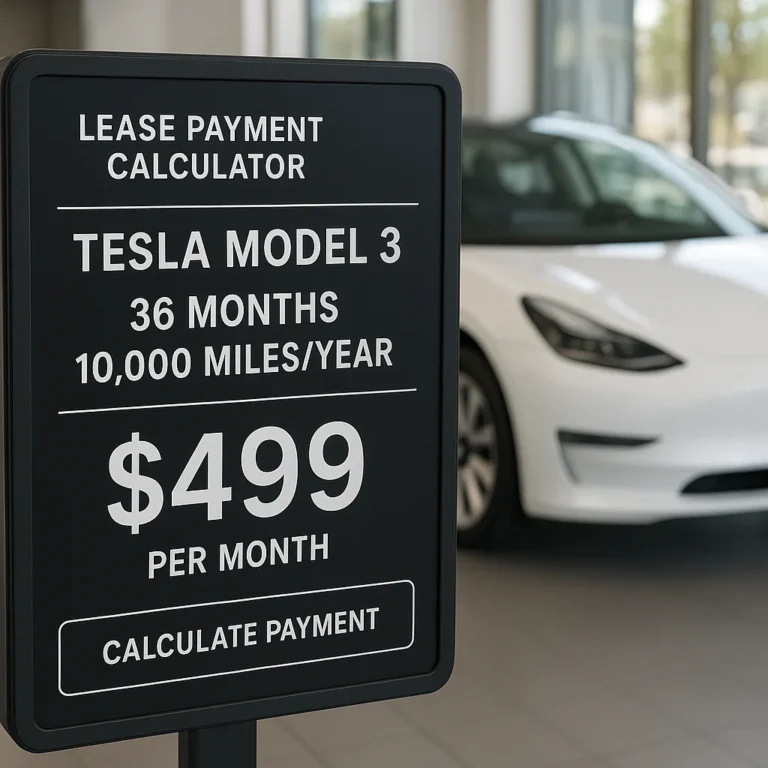
The average monthly lease payment for a Tesla Model 3 typically ranges between $450 and $650 for a 36-month term with 10,0 miles per year. However, this can vary significantly based on the trim level (Standard Range vs. Long Range vs. Performance), your credit score, and current market incentives. Lease deals change frequently, so it’s essential to check the latest offers on the Tesla Official Website.
Read more about “💸 Tesla Model 3 Lease Overage Cost: The 2026 Shock You Can’t Ignore”
How does a Tesla Model 3 lease compare to financing for monthly costs?
Generally, leasing results in a lower monthly payment because you are only paying for the vehicle’s depreciation during the lease term, plus interest and fees. Financing, on the other hand, requires you to pay off the entire purchase price of the car, resulting in higher monthly payments. However, with financing, you own the car at the end of the term, whereas with a lease, you must return the car or buy it out.
Read more about “💸 How Much is a Tesla Model 3 Lease? (2026 Prices Revealed)”
What down payment is required to lower Tesla Model 3 monthly lease payments?
While a down payment (capitalized cost reduction) can lower your monthly lease payment, it is often not recommended for leases. If the vehicle is totaled or stolen, the insurance company pays the lease payoff, and you lose your down payment. Instead, consider negotiating a lower capitalized cost (the price of the car) to reduce your monthly payment without risking your cash upfront.
Are there any current incentives that reduce Tesla Model 3 lease rates?
Incentives change frequently, but Tesla often offers lease specials that include reduced money factors (interest rates) or cash incentives. Additionally, the $7,50 federal tax credit may be applied as a point-of-sale discount for eligible buyers, effectively lowering the capitalized cost of the vehicle. However, for leases, the dealer may capture the tax credit and pass the savings to you in the form of a lower monthly payment, but this is not guaranteed. Always ask your dealer about current incentives.
How much does insurance really cost for a Tesla Model 3?
Insurance costs vary widely based on location, driving history, and coverage levels. On average, expect to pay between $120 and $250 per month for full coverage. Tesla Insurance may offer competitive rates for safe drivers, but it’s crucial to shop around with other providers to ensure you’re getting the best deal.
Read more about “🚀 Tesla Model 3 Zero Down Lease Options: The 2026 Truth”
What are the hidden costs of owning a Tesla Model 3?
Beyond the monthly payment, hidden costs include tires (which wear out faster due to the car’s weight and torque), cabin air filters, wiper blades, and Supercharging fees if you don’t have home charging. Additionally, some states charge an annual EV registration fee to compensate for the lack of gas taxes.
Read more about “🚗 Tesla Model 3 Lease End Process Guide: 12 Steps to Avoid Fees (2026)”
📚 Reference Links