Support our educational content for free when you purchase through links on our site. Learn more
Tesla Model 3 Leasing vs. Financing: Pros & Cons (2026) ⚡

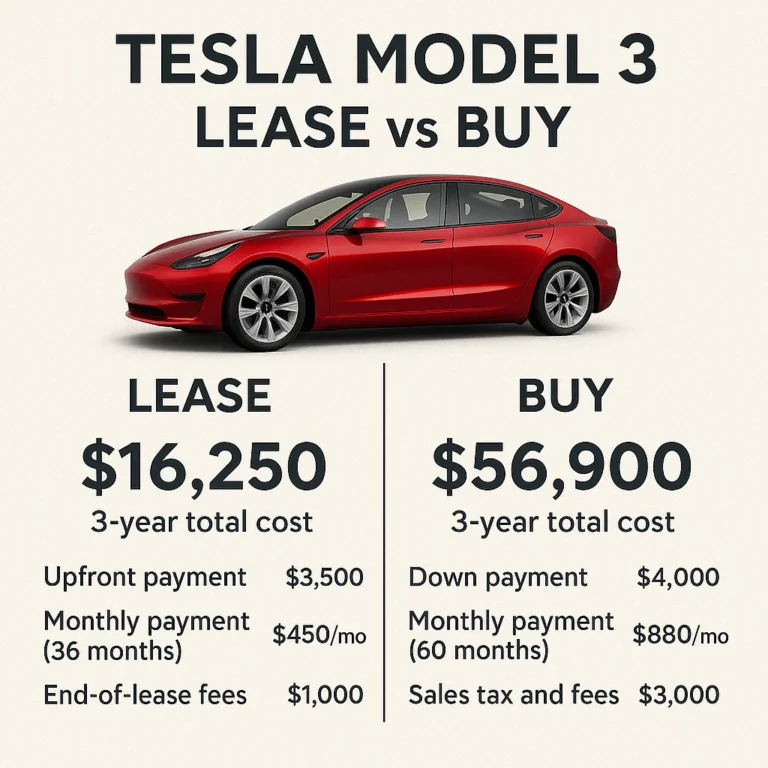
For a Tesla Model 3, leasing tends to suit drivers who want lower payments and a newer car every few years; financing is usually the better fit if you drive a lot or plan to keep the car long-term. The real winner depends on your mileage, loan or lease terms, and whether the lease contract lets you buy the car at the end.
The key trade-off is straightforward: a lease may limit your exposure to resale-value swings, but it also brings mileage and return-condition rules. Financing gives you ownership and freedom to drive as much as you like, while leaving you responsible for depreciation and future repairs.
We’ve seen drivers get excited about a low lease payment, then remember their weekly commute, road trips, and holiday visits all count toward the mileage cap. Before choosing, compare the complete contract—not just the number that looks friendliest on the order page.
Key Takeaways
- Lease for predictable turnover: A lease may fit if you drive within the mileage allowance and want to upgrade every few years.
- Finance for freedom and ownership: Financing is often a better match for high-mileage drivers and people who plan to keep the Model 3 after paying off the loan.
- Compare total costs, not just monthly payments: Include upfront costs, interest or lease charges, insurance, charging, taxes, and potential lease-end fees.
- Confirm lease buyout rights in writing: Tesla lease-end purchase rules can depend on the specific agreement and region.
- Check incentives and current terms: EV tax-credit rules and Tesla offers can change, so verify eligibility and contract details before committing.
Table of Contents
- ⚡️ Quick Tips and Facts: Tesla Model 3 Leasing vs. Financing
- 🚘 Tesla Model 3 Leasing and Financing: Background and Key Changes
- How a Tesla Model 3 Lease Works
- How Financing a Tesla Model 3 Works
- ⚖️ Tesla Model 3 Lease vs. Finance: The Pros and Cons
- 1. Leasing a Tesla Model 3: Pros and Cons
- 2. Financing a Tesla Model 3: Pros and Cons
- 💰 Tesla Model 3 Leasing vs. Financing Costs: What Should You Compare?
- Monthly Payments, Down Payments, and Total Cost of Ownership
- Interest Rates, Lease Money Factors, and Credit Scores
- Taxes, Fees, Incentives, and EV Tax Credit Rules
- Insurance, Charging, Maintenance, and Tire Costs
- Depreciation, Resale Value, and Equity
- 🧮 How to Compare a Tesla Model 3 Lease Quote With a Finance Offer
- A Step-by-Step Cost Comparison
- Lease-End Purchase Options and Residual Value
- Why the Lowest Monthly Payment May Not Be the Best Deal
- 🔋 Battery Life, Range, and Tesla Model 3 Ownership Risks
- Battery Warranty and Long-Term Degradation
- Charging Habits, Home Charging, and Supercharging
- Software Updates, Repairs, and Out-of-Warranty Costs
- 🛣️ Mileage Limits, Wear, and Lease-End Fees
- Choosing an Annual Mileage Allowance
- Excess Mileage, Damage, and Disposition Fees
- What Happens When You Return a Leased Tesla?
- 🔄 Can You Buy Out, Transfer, or Exit a Tesla Model 3 Lease?
- Tesla Lease Buyout Rules
- Lease Transfers, Early Termination, and Trade-Ins
- Selling or Trading a Financed Model 3
- 🆕 New vs. Used Tesla Model 3: Lease, Finance, or Pay Cash?
- When a New Model 3 Lease Makes Sense
- Financing a Used Tesla Model 3
- Used-EV Incentives, Battery Health, and Vehicle History
- 👤 Which Tesla Model 3 Lease or Finance Option Fits Your Situation?
- Best Choice for Low-Mileage Drivers
- Best Choice for High-Mileage Drivers and Road Trips
- Best Choice for Keeping a Car Long-Term
- Best Choice for Business Use
- Best Choice for Drivers Who Want the Latest Tesla Technology
- 📋 Tesla Model 3 Lease and Finance Checklist
- Questions to Ask Before Signing
- Documents and Terms to Review
- ✅ Making the Right Tesla Model 3 Lease-or-Finance Decision
- 🏁 Conclusion
- 🔗 Recommended Links
- ❓ FAQ
- Is it cheaper to lease or finance a Tesla Model 3?
- Can you buy a Tesla Model 3 at the end of a lease?
- Can you lease a Tesla Model 3 with no money down?
- How many miles can you drive on a Tesla Model 3 lease?
- Do Tesla leases include maintenance or repairs?
- Can you end a Tesla Model 3 lease early?
- Is financing a Tesla Model 3 better for long-term ownership?
- Does leasing or financing qualify for EV tax incentives?
- 📚 Reference Links
⚡️ Quick Tips and Facts: Tesla Model 3 Leasing vs. Financing
For a current payment benchmark, see our guide to how much a Tesla Model 3 lease costs. At Car Leases™, our short version is simple: lease if you value predictable terms and frequent upgrades; finance if you want mileage freedom and plan to keep the car. The right choice depends on the complete contract, not the monthly payment alone.
| What matters | Leasing | Financing |
|---|---|---|
| Who owns the car? | The leasing company owns it | You own it after the loan is paid off |
| Monthly payment | Often lower, but depends on the deal | Often higher for the same vehicle and term |
| Mileage | Contract limits apply | No lease mileage cap |
| End of term | Return, replace, or buy only if permitted by your contract | Keep, sell, or trade |
| Depreciation risk | Mostly sits with the lessor | You bear it as the owner |
| Best fit | Drivers who like newer cars and predictable turnover | Drivers who keep cars, drive more, or want ownership |
- Don’t assume a Tesla lease includes a purchase option. Confirm lease-end rules in the actual agreement, in writing.
- Compare total outlay: due-at-signing amount, monthly payments, taxes, fees, insurance, charging, and end-of-term charges.
- 👉 Shop the financing rate. Tesla’s direct-sales model limits traditional dealer negotiation, but you can compare its financing offer with banks and credit unions. CarSaver makes the same practical point: the vehicle price may be fixed, but your financing rate is not.
- Check current incentives before choosing. EV tax-credit eligibility and rules can change; verify the exact vehicle and transaction with the IRS clean vehicle credit guidance.
- Get an insurance quote before you commit. A lower payment can be less impressive when the insurance premium arrives.
For more on EV-specific lease considerations, visit our Electric Vehicle Leases and Car Lease Basics guides.
🚘 Tesla Model 3 Leasing and Financing: Background and Key Changes

The Model 3 has evolved through changes to its design, equipment, range, pricing, and available incentives. That matters because old reviews and expired lease promotions are not reliable forecasts for a current deal. For example, a competing article’s 2024 financing promotion and payment illustration are historical examples—not current offers. Today’s terms depend on the vehicle configuration, location, credit approval, taxes, and incentives.
Tesla sells directly to consumers, so the process differs from the traditional dealership routine. You can review current vehicles and ordering details on the Tesla Model 3 page, then compare the actual lease or loan paperwork with outside financing options. We still recommend a test drive: the Model 3’s low seating position, minimalist controls, and regenerative braking can feel brilliant to one driver and like a brief learning curve to another.
How a Tesla Model 3 Lease Works
A lease is a contract to use a vehicle for a set term. Your payment generally reflects the vehicle’s expected depreciation during that term, financing charges, taxes, and fees. The lease agreement sets the mileage allowance and defines how the vehicle must be returned.
Before signing, check:
- The capitalized cost, or negotiated amount used to calculate the lease.
- The residual value, which estimates the vehicle’s value at lease end.
- The money factor or lease interest disclosure.
- The term, mileage allowance, due-at-signing amount, taxes, and fees.
- The rules for wear, excess mileage, early termination, and lease-end purchase.
A fixed residual can protect a lesee from some market depreciation: if used-car values fall, the lessor generally bears that market risk, subject to the agreement. But you do not automatically benefit if the car’s market value rises. That upside belongs to the lessor unless the contract gives you a purchase option at favorable terms.
For the fundamentals, browse our Best Lease Terms and Car Lease Basics guides.
How Financing a Tesla Model 3 Works
With financing, a lender provides a loan to buy the car. You make a down payment if required, then pay principal and interest over the loan term. Once the loan is paid off, you own the vehicle outright.
Your payment is affected by:
- The amount financed after any down payment or eligible incentives.
- The annual percentage rate (APR).
- The repayment term.
- Taxes, fees, and optional products rolled into the loan.
A longer loan can reduce the monthly payment while increasing the time you owe money and potentially the total interest. Compare the APR and total amount paid, not just the monthly number. The Consumer Financial Protection Bureau’s auto-loan guide explains key loan terms and shopping considerations.
You can explore our Auto Financing Options and Credit Score and Car Leasing resources before applying.
⚖️ Tesla Model 3 Lease vs. Finance: The Pros and Cons
One competitor summarizes the trade-off neatly: “Leasing offers lower payments and flexibility, while financing provides ownership and long-term cost benefits.” That’s useful as a starting point, not a universal verdict. A low lease payment can come with mileage restrictions and no ownership; a loan can build equity but leaves you exposed to resale value and repair costs later.
1. Leasing a Tesla Model 3: Pros and Cons
Potential advantages
- Lower monthly payments than financing can make a new Model 3 easier to fit into a monthly budget.
- A shorter commitment may suit drivers who want to move into newer hardware or a different EV every few years.
- Less direct exposure to resale-market swings because the contract usually sets a residual value.
- The vehicle may remain within applicable warranty coverage during much or all of the lease, depending on term and mileage. Verify coverage with Tesla’s warranty information.
Potential drawbacks
- Mileage limits can be costly for commuters and frequent road-trippers.
- You have no ownership equity from ordinary lease payments.
- Wear, damage, and early termination can lead to charges under the contract.
- You may not be allowed to buy the vehicle at lease end. Rules can vary by agreement and jurisdiction, so do not rely on an old article or an online anecdote.
- You may have to keep making payments or start another lease if you want to remain in a new car.
We’ve seen drivers focus on the lease payment and forget the commute. A 10,000-mile allowance sounds roomy until a long weekly commute, weekend trips, and one ambitious holiday road trip start adding up. Estimate annual mileage before you choose the term.
2. Financing a Tesla Model 3: Pros and Cons
Potential advantages
- No contractual mileage cap.
- You can keep the Model 3 after the loan ends, sell it, or trade it subject to any outstanding loan balance.
- You have more freedom to personalize the vehicle, while still following warranty, safety, and local legal requirements.
- Keeping the car for many years can spread its purchase cost over a longer period, especially once loan payments end.
Potential drawbacks
- Payments can be higher than a lease payment for a comparable term.
- You bear the risk that market value falls, including after manufacturer price changes.
- You are responsible for repair and maintenance costs not covered by warranty.
- A long loan can leave you owing more than the vehicle is worth, especially if you make a small down payment or the car depreciates quickly.
The DIY Wrap Club summary emphasizes mileage freedom, customization, and possible resale value as buying benefits. CarSaver, meanwhile, cautions that a buyer personally bears depreciation risk. Both can be right: resale value depends on the purchase price, market conditions, vehicle condition, and how long you keep it.
💰 Tesla Model 3 Leasing vs. Financing Costs: What Should You Compare?
Avoid comparing one advertised monthly lease payment with a loan payment and calling it a day. Build a side-by-side estimate using the same vehicle configuration, time period, and assumptions. For state-specific lease-versus-purchase sales-tax differences, see your state’s tax authority; the rules can differ substantially.
Monthly Payments, Down Payments, and Total Cost of Ownership
Use this framework:
| Cost item | Lease | Finance |
|---|---|---|
| Amount due at signing | Down payment or capitalized-cost reduction, first payment, fees, and taxes may apply | Down payment, taxes, registration, and fees may apply |
| Monthly payments | Contract payments for the lease term | Loan payments until the balance is paid |
| End-of-term amount | Possible mileage, wear, disposition, or permitted purchase charges | Remaining loan balance, if any |
| Value afterward | Usually no vehicle ownership unless a purchase option applies | Vehicle equity may remain, depending on market value and loan balance |
| Long-term ownership | Requires buying or leasing another vehicle | Payments end after the loan is paid; ownership continues |
To compare fairly, calculate both the cash outlay over your planned ownership period and what you have at the end. A lease may cost less in monthly payments but leave you with no vehicle. A loan may cost more during the term but leave you with a car that still has resale value.
Interest Rates, Lease Money Factors, and Credit Scores
Your credit profile can affect the financing rate or lease approval and terms. Get a prequalification where possible, understand whether it involves a hard inquiry, and compare offers from Tesla, banks, and credit unions.
For financing, compare APR, loan term, total interest, and total payments. For leasing, ask how the money factor is disclosed and review the residual, fees, and full payment schedule. Do not treat a low monthly payment as proof of a low-cost deal.
Our Credit Score and Car Leasing guide covers credit factors, while the CFPB provides consumer guidance on auto-loan shopping.
Taxes, Fees, Incentives, and EV Tax Credit Rules
Tax treatment can change the comparison. Depending on state law, sales tax may be applied to lease payments, the vehicle price, or another taxable amount. Ask the leasing company or a qualified tax professional how the rule applies to your contract.
EV incentives also require careful checking:
- Eligibility can depend on the exact vehicle, purchase or lease structure, taxpayer circumstances, location, and current law.
- A lesee generally does not claim a purchase credit in the same way an eligible buyer might; a lessor may receive an incentive and may pass some value through in lease terms.
- Do not assume an advertised incentive applies to your Model 3 or can be combined with every offer.
The IRS provides current information on clean vehicle credits. Verify your specific transaction before budgeting around a credit.
Insurance, Charging, Maintenance, and Tire Costs
Get an insurance quote for the exact Model 3 configuration and your home address before signing. Premiums vary by driver, coverage, location, vehicle repair costs, and insurer. Tesla Insurance is available only in certain markets; compare it with other providers rather than assuming it will be cheapest.
Also budget for:
- Charging: Home charging can be convenient, but installation and electricity costs vary. Public charging costs depend on the network and location.
- Tires: EV weight and instant torque can make tire choice and driving style important to tire wear. Check the vehicle’s maintenance guidance and your tire warranty.
- Repairs: Warranty coverage is not the same as full maintenance coverage. Review Tesla’s warranty terms.
- Roadside and service access: Consider how far you live from Tesla service locations and what support your warranty or insurance provides.
Tesla provides guidance on home charging and Supercharging. If home charging is not practical, model your local public-charging routine before committing to an EV.
Depreciation, Resale Value, and Equity
Financing means you own the market-value risk. If resale values fall, your Model 3 may be worth less than the remaining loan balance. If you lease, the contract’s residual value generally shields you from ordinary market depreciation at return, but you still owe agreed payments and may face condition or mileage charges.
Do not buy solely because you expect the Model 3 to appreciate or hold value. Cars are transportation, not guaranteed investments. A strong purchase case usually comes from keeping the car long enough to benefit from ownership, managing charging and insurance costs, and being comfortable with resale uncertainty.
🧮 How to Compare a Tesla Model 3 Lease Quote With a Finance Offer
Here’s the practical method we use when two offers look like they’re speaking different languages.
A Step-by-Step Cost Comparison
- Choose the same Model 3 configuration. Compare like-for-like trim, options, and delivery terms.
- Set the same time horizon. A three-year lease and a six-year loan should not be compared using only their monthly payments.
- Record all cash due at signing. Include down payment, fees, taxes, and first payment.
- Add every scheduled payment. Use the exact contract term and monthly amount.
- Add foreseeable operating costs. Compare insurance, electricity, charging access, and routine tire needs.
- Include lease-end risks. Check mileage, wear, disposition, and early-exit terms.
- Estimate the financed car’s value and loan balance at your chosen endpoint. Use conservative resale assumptions and subtract any remaining debt.
- Check incentives and taxes. Confirm eligibility and local treatment with reliable sources.
- Compare the complete result. Ask which arrangement fits your driving, cash flow, and ownership plans—not merely which has the smaller payment.
| Question | Why it matters |
|---|---|
| How much is due at signing? | A low monthly payment may be created by a large upfront payment |
| What is the total payment obligation? | Shows the committed cost over the term |
| What happens at the end? | A lease return and an owned car are different outcomes |
| What is the annual mileage? | Prevents a lease from becoming an overage trap |
| Is a buyout permitted? | Affects whether you can keep the car |
| What does insurance cost? | Can change the affordability picture substantially |
Lease-End Purchase Options and Residual Value
Do not assume that a lease automatically gives you the right to buy the Model 3. Policies can differ by leasing entity, contract, region, and time. Before signing, ask:
- Is a purchase option available for this specific lease?
- Is the buyout price fixed, or will it be calculated later?
- Are taxes, purchase-option fees, or other costs added?
- Can you sell the car to a third party or only purchase it yourself?
The competing sources disagree on lease buyouts because they may describe different contracts or policy periods. One says Tesla Model 3 and Model Y leases do not allow buyouts; CarSaver advises checking the model- and region-specific restrictions. Trust your signed agreement and current Tesla account terms—not a generic rule from an older article.
Why the Lowest Monthly Payment May Not Be the Best Deal
A low lease payment can be paired with a large due-at-signing amount, a low mileage cap, or fees that appear later. A low loan payment can come from stretching the term so long that you pay more interest and remain in debt longer.
Compare the effective cost and end position:
- How much cash leaves your pocket?
- What flexibility do you give up?
- How much mileage can you drive?
- Will you own a vehicle at the end?
- What happens if you need to exit early?
The CFPB’s auto-loan shopping resources are useful for checking loan details. For lease-specific terminology, see our Best Lease Terms guide.
🔋 Battery Life, Range, and Tesla Model 3 Ownership Risks
A lease can be appealing when you’re unsure how battery technology, vehicle values, or your own driving habits will change. Financing makes more sense if you’re comfortable keeping the car through those changes. Neither choice makes range or battery health irrelevant; it just changes who owns more of the long-term risk.
Battery Warranty and Long-Term Degradation
Tesla’s battery and drive-unit coverage varies by Model 3 version and is subject to the specific warranty terms. Check the current Tesla vehicle warranty page for duration, mileage limits, and conditions.
Battery capacity can decline over time, but the actual experience depends on the vehicle, climate, charging patterns, and use. Avoid treating a single owner’s range report as a prediction for every car. The U.S. Department of Energy’s Alternative Fuels Data Center explains general EV maintenance and operating considerations.
For a used Model 3, review available battery and vehicle-health information, service records, and the remaining warranty rather than relying only on the dashboard estimate.
Charging Habits, Home Charging, and Supercharging
Home charging can make ownership especially convenient: plug in overnight and start most mornings ready to go. But apartment residents or drivers without reliable home or workplace charging should map out nearby public options first.
Tesla explains the options for home charging and Supercharging. When comparing lease and finance, use your actual commute and charging access—not an EPA range figure alone. Weather, speed, terrain, and cabin heating or cooling affect real-world energy use.
Software Updates, Repairs, and Out-of-Warranty Costs
Tesla vehicles receive software updates, but do not lease or finance on the assumption that every future feature will arrive or be included. Review what is standard, what is optional, and what terms apply to paid features directly with Tesla.
Owners should consider repair access and potential out-of-warranty costs. Leses are not exempt from responsibility for damage, misuse, or contract-defined charges. Financing gives you more control over how long you keep the car, but it also means you remain responsible for repair decisions after coverage ends.
🛣️ Mileage Limits, Wear, and Lease-End Fees
A lease’s mileage allowance is not decorative fine print. It is a prediction of how you drive—and an expensive place to be optimistic.
Choosing an Annual Mileage Allowance
Estimate your mileage using:
- Your ordinary daily or weekly commute.
- Weekend and holiday trips.
- Work travel, school runs, and family obligations.
- Any likely change in job or living situation.
A competing guide gives common annual allowances such as 10,000, 12,000, or 15,000 miles, but the available choices and overage charges depend on the actual contract. Read your offer rather than assuming those figures apply. If you regularly drive a lot, financing may be simpler than paying for extra lease mileage or worrying about the odometer.
Excess Mileage, Damage, and Disposition Fees
Your lease documents define what counts as excess mileage and chargeable wear. Before signing, ask for the inspection standards and fee schedule. Keep photos of the vehicle at delivery and at return, and address damage early if your agreement allows it.
Ordinary use is not the same as neglect, but definitions vary. Scraped wheels, damaged glass, missing equipment, and significant interior damage may be treated differently from minor wear. Check Tesla’s lease return information and your own contract for current instructions.
What Happens When You Return a Leased Tesla?
At lease end, follow the lessor’s return process and confirm:
- Your scheduled return date and location.
- Whether an inspection is required.
- How to handle keys, charging equipment, accessories, and personal data.
- Any mileage, condition, or disposition charges.
- Whether you can extend, replace, or purchase the vehicle under your agreement.
Remove personal accounts and information according to Tesla’s guidance, and retain proof of return. Your lease contract—not a general checklist—is the final authority on what you owe.
🔄 Can You Buy Out, Transfer, or Exit a Tesla Model 3 Lease?
A lease is harder to unwind than a casual subscription. Read the exit terms before signing, especially if your job, household, or commute could change.
Tesla Lease Buyout Rules
Buyout availability depends on the specific lease terms and applicable rules. Some articles report that Tesla does not permit lease-end purchases for certain Model 3 leases; other guidance stresses that restrictions can vary. That is why the safest answer is confirm it for your specific agreement, in writing, before accepting delivery.
If a buyout is allowed, compare the contractual purchase amount with the car’s market value and include taxes, fees, and financing costs. A buyout is not automatically a bargain.
Lease Transfers, Early Termination, and Trade-Ins
Do not assume you can transfer a Tesla lease to another driver or return the vehicle early without cost. Transfer eligibility and early-termination calculations depend on the lessor and contract. Contact Tesla or the named leasing company for an official payoff or exit quote before making plans.
The financially safest approach is to treat the full lease term as a commitment. If your situation changes, ask about approved options before missing payments or handing back the car unexpectedly.
Selling or Trading a Financed Model 3
You can generally sell or trade a financed car, but the loan must be paid off. Request a current payoff amount, compare it with a credible purchase or trade-in offer, and account for any difference:
- Positive equity: The car’s sale value exceeds the loan payoff.
- Negative equity: The payoff exceeds the sale value, and you must address the shortfall.
Do not roll negative equity into another loan without understanding the added cost and risk. The CFPB offers practical guidance on auto-loan decisions.
🆕 New vs. Used Tesla Model 3: Lease, Finance, or Pay Cash?
A used Model 3 can reduce the amount you borrow, but used-EV shopping calls for extra homework. You’re assessing not only the asking terms, but also battery warranty, accident history, software configuration, tires, and service records.
When a New Model 3 Lease Makes Sense
A new lease may fit you if you:
- Drive within the mileage allowance.
- Prefer a newer vehicle and predictable changeover.
- Want to limit personal exposure to used-market depreciation.
- Are comfortable returning the car rather than automatically owning it.
Check current vehicle details and terms on the Tesla Model 3 page. Older reviews may feature previous range estimates, trims, prices, or incentives, so use current official information for the vehicle you are actually ordering.
Financing a Used Tesla Model 3
A used Model 3 may suit a high-mileage driver or long-term keeper who does not need the newest version. Compare the vehicle’s condition and loan APR against the cost of a new lease or new financed vehicle.
Before purchase, review:
- Vehicle history and title status.
- Remaining battery and drive-unit warranty.
- Service and repair history.
- Tire condition and replacement needs.
- Charging equipment and included accessories.
- Any software features and whether they transfer.
Compare financing from Tesla and outside lenders. Our Auto Financing Options guide can help you evaluate loan terms.
Used-EV Incentives, Battery Health, and Vehicle History
Used clean-vehicle credits have specific requirements and can change under federal law. Check current IRS guidance and confirm eligibility for the particular vehicle and transaction. Do not count an incentive until you have verified the rules.
For battery health, use available vehicle diagnostics and professional inspection where appropriate. For vehicle history, check credible records and inspect the car in person. A low odometer reading is useful, but it does not reveal every detail about charging, climate exposure, or prior repairs.
👤 Which Tesla Model 3 Lease or Finance Option Fits Your Situation?
Best Choice for Low-Mileage Drivers
A lease can work well if your annual mileage is stable and comfortably below the allowance. You may value lower payments and the ability to switch vehicles at lease end. Confirm the total due at signing and return conditions before deciding.
Best Choice for High-Mileage Drivers and Road Trips
Financing is often the more straightforward fit if you drive long distances or dislike tracking mileage. You can take road trips without worrying about a contract cap, although charging stops and operating costs still deserve planning.
Best Choice for Keeping a Car Long-Term
Financing is usually the stronger fit if you expect to keep the Model 3 well beyond the loan term. Once paid off, you can continue driving without monthly loan payments—while still budgeting for insurance, tires, repairs, and charging.
Best Choice for Business Use
Business treatment depends on how the vehicle is used, its ownership structure, local rules, and applicable tax law. Keep accurate records and consult a qualified tax professional before assuming a lease or loan creates a specific deduction. The IRS business vehicle guidance is a place to start.
Best Choice for Drivers Who Want the Latest Tesla Technology
Leasing may suit drivers who want to reconsider their vehicle every few years, especially as hardware and software offerings evolve. Financing can still make sense if you’re happy with the current vehicle and prefer long-term ownership. Buy or lease the car you want now, not a promise about features that might arrive later.
📋 Tesla Model 3 Lease and Finance Checklist
Questions to Ask Before Signing
- What is the total due at signing?
- What is the total of all scheduled payments?
- What are the lease mileage allowance and excess-mileage terms?
- What counts as excessive wear?
- Is a lease-end purchase option available for this exact agreement?
- What happens if I need to exit early?
- What is the loan APR, term, and total interest?
- Have I obtained an insurance quote for this specific vehicle?
- What warranty coverage applies, and when does it end?
- Which incentives apply to my vehicle, location, and transaction?
Documents and Terms to Review
Read the full contract, not just the order page or payment summary. Keep copies of:
- The lease or retail installment contract.
- The itemized payment and fee breakdown.
- Warranty and return-condition information.
- Incentive and tax eligibility documentation.
- Insurance quote and coverage selections.
- Any written confirmation about buyout or transfer rights.
For general lease guidance, visit Car Lease Basics. For loan terms, review the CFPB auto-loan guide.
✅ Making the Right Tesla Model 3 Lease-or-Finance Decision
Use this quick decision filter:
| If this sounds like you… | Start by comparing… |
|---|---|
| “I want a new car every few years.” | Leasing, including mileage and return terms |
| “I drive a lot and hate restrictions.” | Financing, including APR and resale assumptions |
| “I’ll keep the car for years.” | Financing and the full long-term ownership cost |
| “I’m nervous about resale values.” | Leasing, while checking upfront costs and return rules |
| “I want to keep the car after the term.” | Financing, or a lease only if the purchase option is confirmed |
| “I don’t have home charging.” | Charging access and costs before either contract |
The first YouTube video takes a Model Y-focused view of lease versus finance, discussing sales-tax differences, wear, and possible lease buyout value. Its core lesson—that a lease offer is not automatically the best offer—is useful for Model 3 shoppers too. But its tax and buyout examples are not universal: state tax rules and lease contracts differ, and Model Y figures do not establish Model 3 terms.
A useful contrast comes from CarSaver, which says leasing can suit “most shoppers wary of fast depreciation,” while recommending buying for “confident long keepers with home charging.” We agree with the underlying logic, with one caveat: the best choice still depends on your actual contract, local taxes, credit offer, annual mileage, and insurance quote.
Our recommendation: lease when you value predictable turnover, drive within the cap, and are comfortable returning the car. Finance when you drive more, want customization, or plan to keep the Model 3 long enough to own it outright. Before choosing either, compare the real offers line by line—and confirm buyout rights before signing if keeping the car matters to you.
Sources and helpful links