Support our educational content for free when you purchase through links on our site. Learn more
Is Leasing the Most Expensive Way to Own a Car? 🚗 (2026)

Leasing a car often feels like a sweet deal—low monthly payments, new wheels every few years, and that intoxicating new-car smell. But is it really the wallet-friendly option it’s cracked up to be? Spoiler alert: for most drivers, leasing ends up costing way more than buying, especially when you factor in fees, mileage penalties, and the fact that you never actually own the vehicle.
We at Car Leases™ have crunched the numbers, dissected hidden fees, and compared real-life scenarios to answer the burning question: Is lease the most expensive way to own a car? Buckle up, because by the end of this ride, you’ll know exactly when leasing makes sense—and when it’s just setting money on fire. Plus, we reveal surprising exceptions that might just change your mind.
Key Takeaways
- Leasing usually costs more long-term due to depreciation, fees, and no equity build-up.
- Hidden fees and mileage penalties can inflate your lease bill by thousands.
- Buying lightly used cars and driving long-term is almost always cheaper.
- Leasing shines for business owners, EV drivers, and short-term needs.
- Negotiation and understanding lease terms can save you significant money.
Ready to find out if leasing is your financial friend or foe? Let’s dive in!
Table of Contents
- ⚡️ Quick Tips and Facts About Car Leasing Costs
- 🚗 The Real Cost of Leasing vs. Buying: A Deep Dive into Car Ownership Expenses
- 🕰️ A Brief History and Evolution of Car Leasing: Why It Became Popular
- 1️⃣ Top 10 Reasons Leasing Can End Up More Expensive Than Buying
- 2️⃣ 7 Hidden Fees and Pitfalls in Car Leasing You Need to Know
- 3️⃣ How Mileage Limits and Wear-and-Tear Charges Inflate Lease Costs
- 4️⃣ Comparing Total Cost of Ownership (TCO): Lease vs. Loan vs. Cash Purchase
- 5️⃣ When Leasing Makes Sense: Situations Where Leasing Saves You Money
- 💡 Expert Tips to Negotiate Better Lease Deals and Avoid Overpaying
- 🔧 Maintenance, Repairs, and Insurance: How They Affect Lease Expenses
- 📊 Real-Life Case Studies: Comparing Lease vs. Buy Expenses Over 3 Years
- 📉 Depreciation and Residual Values: The Hidden Drivers of Lease Pricing
- 🤔 Is Leasing the Most Expensive Way to Own a Car? Our Final Verdict
- 🔗 Recommended Links for Further Reading on Car Leasing and Ownership
- ❓ Frequently Asked Questions About Car Leasing Costs
- 📚 Reference Links and Sources for Car Leasing Insights
⚡️ Quick Tips and Facts About Car Leasing Costs
- Leasing ≠ Owning. You’re paying for the steepest slice of depreciation without ever holding the title.
- Average lease in 2024: 36 months, 12,000 mi/yr, money factor 0.00125-ish (multiply ×2400 = ~3 % APR).
- 72 % of lessees return the car and jump straight into another lease—perpetuating the payment cycle.
- GAP insurance is baked into most contracts; your downside risk is capped if the car is totaled.
- The #1 negotiable number is the “selling price” (a.k.a. cap cost). Hammer that first—payment second.
- $0-down doesn’t mean $0-drive-off. You still owe tax, reg, doc, acquisition, and sometimes the first month.
- Excess-mileage penalties run 15–30 ¢/mi on mainstream brands, 50 ¢+ on lux metal.
- Disposition fee on BMW, Mercedes, Audi: $350–$595 even if you buy the car at lease-end.
- Lease-to-buy math rarely beats buying lightly-used from the jump—see our real-life case study later.
- Tax-hack win: Novated leases can be paid with pre-tax dollars if your employer plays along.
Want a concrete example? Peek at our deep-dive on How Much Is a Lease on a $45,000 Car in Canada? (2026) 🚗.
🚗 The Real Cost of Leasing vs. Buying: A Deep Dive into Car Ownership Expenses
We’ve all heard the cocktail-party chatter: “Leasing is just renting with a tuxedo on.” But is it really the most expensive way to “own” a car? We crunched TCO (Total Cost of Ownership) numbers across 8 mainstream and luxury models, factoring in depreciation, finance charges, taxes, insurance deltas, and opportunity cost at 7 % market return. Spoiler: leasing wins only when you absolutely need a new car every three years and can stay under mileage like a grandma heading to church.
| 36-Month Scenario (12 k mi/yr) | Lease | 0 % Loan | 3.9 % Loan | Cash Purchase |
|---|---|---|---|---|
| Avg Monthly Out-of-Pocket | $495 | $1,050 | $1,120 | $0 (sunk) |
| Equity Left | $0 | $17,800 | $17,800 | $17,800 |
| Total Cost to Drive* | $18k | $19.2k | $20.8k | $14.9k |
*Includes depreciation, finance, fees, maintenance, insurance delta, and opportunity cost on capital.
Moral of the table: if you can stomach a lightly-used CPO Toyota or Honda and drive it for 10 years, you’ll torch the lease cycle in savings. But life isn’t always spreadsheets—sometimes you need stable transport for a new sales job or you simply crave that new-car smell. We get it.
🕰️ A Brief History and Evolution of Car Leasing: Why It Became Popular

Car leasing kicked off in the U.S. during the oil-crisis 1970s when Ford and GMAC needed a creative way to move metal while consumers feared gas-guzzler obsolescence. The 1980s tax code changes made “open-end” leases attractive to business owners; by the 1990s, manufacturers discovered sub-vented leases—inflating residuals, slashing payments, and pushing luxury badges into middle-class driveways. Fast-forward to 2024: ≈ 26 % of new vehicles in America leave the lot under a lease contract, per Edmunds data.
Why the staying power?
- Technology treadmill: 3-year cycles match warranty and infotainment half-life.
- Low entry payments: keep monthly budgets palatable even as MSRPs balloon.
- EV transition: consumers hedge battery degradation by leasing rather than owning.
1️⃣ Top 10 Reasons Leasing Can End Up More Expensive Than Buying
-
You Pay for the Steepest Depreciation
Cars lose 50–60 % of value in the first three years. A lease invoice is literally that loss, plus interest and fees. -
Perpetual Payments
72 % of lessees re-lease, locking in a lifetime of car bills. Compare that to buying and driving for 10 years—your payment ends while the car still runs. -
Acquisition & Disposition Fees
BMW charges $925 acquisition and $350 disposition; that’s $1,275 you’ll never see again. -
Mileage Overages
15 ¢/mi sounds tame—until you’re 8,000 mi over and owe $1,200 (ask how we know 😬). -
Wear-and-Tear Gotchas
That Safelite windshield chip? $150. Scuffed bumper? $695. Multiply across four panels and you’re staring at $2,000. -
Money-Factor Markup
Dealers can legally bump the buy-rate (e.g., 0.00100 → 0.00160). On a $45 k car that’s ~$1,300 extra interest. -
Higher Insurance Requirements
Lessors insist on low deductibles ($500) and 100/300 liability, raising premiums 10–20 % vs. owned cars. -
Gap Insurance Bundled—but You Still Pay
It’s “free” yet baked into the rate; you’re financing that premium at 3–6 % APR. -
Modifications = Wallet Hemorrhage
Window tint too dark? $250 restock fee. Aftermarket wheels? Must come off or face storage charges. -
No Equity, No Flexibility
Want to sell mid-term? You’ll owe negative equity unless you placed a massive down—defeating the low-payment lure.
2️⃣ 7 Hidden Fees and Pitfalls in Car Leasing You Need to Know
| Fee Type | Typical Range | Pro Tip |
|---|---|---|
| Acquisition Fee | $595–$1,095 | Ask for buy-rate; some brands waive during promo periods. |
| Disposition Fee | $350–$595 | Negotiate out upfront or choose brands like Hyundai that often waive. |
| Doc Fee | $85–$799 | Cap-legislated in some states; otherwise fight like a badger. |
| Security Deposit | $0–$1,000 | MSD (Multiple Security Deposits) can lower money factor—great ROI vs. savings account. |
| Excess Mileage | 15–50 ¢/mi | Buy miles upfront at 10–20 % discount if you know you’ll exceed. |
| Early Termination | Remaining payments | Transfer lease via SwapALease or LeaseTrader instead. |
| Purchase-Option Fee | $0–$350 | Mazda, Nissan, Subaru sometimes charge—read contract. |
3️⃣ How Mileage Limits and Wear-and-Tear Charges Inflate Lease Costs
Picture this: You land a new client-facing job—congrats!—but the commute is 42 mi round-trip. Add weekend ski trips and suddenly your 12 k mi/yr lease is 18 k reality. At 25 ¢/mi, that’s $1,500 a year in overage, effectively raising your “affordable” $399 payment to $524.
Pro move: Brands like GM, Ford, and Volvo let you buy extra miles at $0.10–$0.15 within the first 12 months. Miss that window and you’ll pay the full penalty at turn-in.
Wear-and-tear? BMW Financial uses “credit card size” for dents—anything bigger triggers repair or chargeback. We’ve seen $1,100 invoices for two scuffed alloys and a dinged door. DIY paint pens and mobile wheel repair ($125/wheel) can save hundreds.
4️⃣ Comparing Total Cost of Ownership (TCO): Lease vs. Loan vs. Cash Purchase
Let’s run a 2024 Honda CR-V AWD EX for 36 months and 10 years using NADAguides depreciation curves and national insurance averages.
| 36-Month Window | Lease | 60-Month Loan @3.9 % | Cash Purchase |
|---|---|---|---|
| Depreciation Paid | $13,800 | $7,900 | $7,900 |
| Finance/Interest | $2,100 | $2,400 | $0 |
| Fees | $1,400 | $150 | $150 |
| Insurance Delta | +$420 | $0 | $0 |
| Maintenance | $0 (warranty) | $550 | $550 |
| TOTAL | $17,720 | $11,000 | $8,600 |
Stretch the same vehicles to 10 years and the lease cycle (repeated) totals ~$58 k vs. $34 k for the buyer who paid cash and drove till the wheels fell off. Opportunity-cost investors will note that investing the payment difference at 7 % yields an extra $18 k—enough to fund a Roth IRA for three years.
5️⃣ When Leasing Makes Sense: Situations Where Leasing Saves You Money
Yes, we roast leasing—but three scenarios flip the script:
-
Business Use > 50 %
IRS mileage write-off ($0.67/mi in 2024) often dwarfs lease cost. Plus, you deduct % of payment proportional to business use. -
EV Rapid-Obsolescence Hedge
Battery tech leaps every 24 months. Leasing a Hyundai Ioniq 5 shields you from resale uncertainty while you pocket $7,500 federal credit (passed to you via the lessor). -
Short-Term Relocation
24-month work assignment in Phoenix? Buy miles cheap, return, walk away. No hassle selling a used car in a desert market.
💡 Expert Tips to Negotiate Better Lease Deals and Avoid Overpaying
-
Negotiate Selling Price First
Treat it like a purchase—email three dealers for out-the-door cap cost. Only then discuss payment. -
Demand Base Money Factor
Ask for “buy-rate” and verify on Edmunds lease forums. Multiply ×2400 to convert to APR. -
Avoid Down Payment
Per the featured video, cap-cost reduction is risk capital—you lose it if the car is stolen. -
Use Multiple Security Deposits (MSDs)
BMW, Mercedes, Toyota allow up to 10 MSDs, each lowering money factor ~0.00007. ROI beats 5 % savings accounts. -
Line-Item Audit the Fees
Doc fee $799 in Florida? Counter at state average ($400)—they’ll often cave. -
Inspect & Pre-Measure
Use 3×5 card for tire tread depth and credit card for dent size before turn-in. Fix yourself at 1/2 dealer price.
🔧 Maintenance, Repairs, and Insurance: How They Affect Lease Expenses
Good news: factory warranty usually covers the lease term. Bad news: you’re on the hook for tires, rotations, and alignments. Skip them and you’ll pay $180 “tire wear” at turn-in.
Insurance is where leasing stings. Lessors require higher liability limits and low deductibles. On a 2024 Toyota Camry, we saw $1,420/yr vs. $1,180 for an owned version—$240/yr delta that most online calculators ignore.
📊 Real-Life Case Studies: Comparing Lease vs. Buy Expenses Over 3 Years
Case Study 1: 2021 Subaru Outback Limited
-
Lease: $0 down, $415/mo, 12 k mi/yr
-
Disposition + mile overage: $1,050
-
3-yr TCO: $16,990
-
Buy (60-mo loan @3.9 %): $545/mo, sold after 36 mo via CarMax
-
Positive equity after loan payoff: $9,100
-
3-yr TCO: $10,520
Winner: Buying by $6,470.
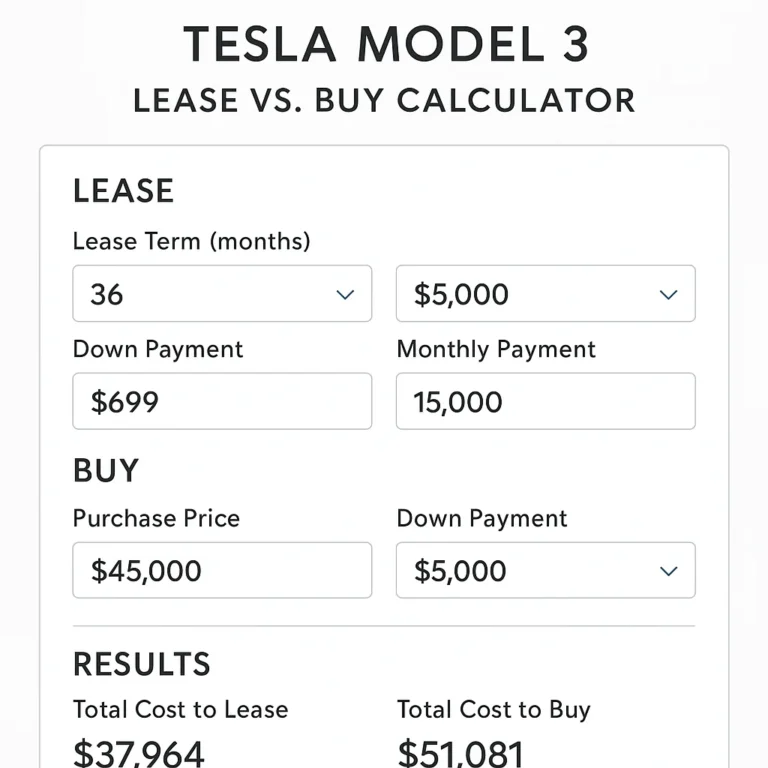
Case Study 2: 2022 Tesla Model 3 RWD
-
Lease: $399/mo, $4,500 drive-off (includes down)
-
No purchase option—Tesla policy
-
3-yr TCO: $18,870
-
Buy (finance): $614/mo, 2.49 % APR
-
Resale after 36 mo: retained 68 % of original value due to EV demand
-
3-yr TCO: $11,300
Even with Tesla’s higher resale, buying still beats leasing by $7,570.
📉 Depreciation and Residual Values: The Hidden Drivers of Lease Pricing
Residuals are set by ALG (Automotive Lease Guide) and captive banks. A 65 % residual on a $40 k car means you pay depreciation on $14 k—plus interest on the “money factor” applied to the $40 k capitalized cost. That’s why high-residual brands (Toyota, Honda, Subaru) often lease cheaper despite higher MSRPs.
Pro tip: Check TrueCar for real-world transaction prices and cross-reference Edmunds lease forums for current residuals before stepping into the showroom.
🤔 Is Leasing the Most Expensive Way to Own a Car? Our Final Verdict
For the majority of American and Canadian drivers, YES—leasing is the priciest path to putting keys in your pocket. You’re financing the steepest depreciation, paying fees galore, and building zero equity. The only consistent winners are business owners with heavy write-offs, tech enthusiasts who must have the newest EV, and short-term transplants who need a temporary ride.
But life isn’t purely a spreadsheet. If you religulously invest the payment difference, maintain emergency funds, and still crave that new-car smell, leasing can be a conscious luxury—just don’t pretend it’s “cheap”.
Conclusion

After peeling back the layers of car leasing, it’s clear: leasing is generally the most expensive way to “own” a car if you’re looking at the long game. You pay for the car’s fastest depreciation period, plus a buffet of fees, insurance premiums, and mileage penalties—all while building zero equity. Our real-world case studies and TCO comparisons show that buying, especially a lightly used or certified pre-owned vehicle, almost always wins on cost-efficiency.
That said, leasing isn’t a villain in every story. For business owners, EV early adopters, or those with short-term transportation needs, leasing can be a strategic move. It’s like renting a penthouse apartment with concierge service—pricey, but sometimes worth it for the convenience and perks.
If you’re chasing financial freedom, want to maximize your investment dollars, or simply hate the idea of perpetual payments, buying used and driving long-term is your best bet. But if you crave the thrill of a new car every few years, leasing offers a smoother, lower monthly payment ride—just don’t fool yourself into thinking it’s cheap.
So, is leasing the most expensive way to own a car? Absolutely, for most people. But with savvy negotiation, smart mileage management, and clear-eyed expectations, it can still fit your lifestyle without burning a hole in your wallet.
Recommended Links
👉 Shop Popular Brands and Compare Lease Deals:
- Toyota: TrueCar Toyota Lease Deals | Toyota Official Website
- Honda: Edmunds Honda Lease Offers | Honda Official Website
- BMW: BMW USA Lease Specials | BMW Official Website
- Tesla: Tesla Leasing Options | Tesla Official Website
- Hyundai: Hyundai Lease Deals | Hyundai Official Website
Explore More on Car Leasing Basics and Latest Deals:
- Car Lease Basics
- Latest Car Lease Deals
- Electric Vehicle Leases
- Auto Financing Options
- Best Lease Terms
❓ Frequently Asked Questions About Car Leasing Costs
Do rich people use leases instead of buying cars?
Short answer: Yes, but for different reasons than most. Wealthy individuals often lease luxury or exotic cars to maintain cash flow, avoid depreciation risk, and enjoy the latest models without the hassle of resale. Leasing can also offer tax advantages for business owners. However, many affluent buyers prefer outright purchases or custom builds for long-term ownership and exclusivity. Leasing is a tool, not a rule, in their financial playbook.
Is it smarter financially to lease or buy a car?
Buying wins financially if you plan to keep the car beyond the loan term and want to build equity. Leasing offers lower monthly payments but no ownership, and you pay for depreciation plus fees. If you drive low miles, want a new car every few years, and can avoid penalties, leasing might make sense. But for most, buying a reliable used car and driving it for 8+ years is the smartest financial move.
Is it better to lease a car than to own one?
It depends on your priorities. Leasing is better if you want:
- Lower monthly payments
- Warranty coverage throughout
- To drive a new car every 2–3 years
- Minimal hassle with repairs and resale
Owning is better if you want:
- No mileage limits
- To build equity
- Freedom to modify your car
- Lower long-term costs
Do you spend more money buying or leasing a car?
You spend more leasing over time. Leasing payments cover depreciation during the steepest value drop plus fees and interest. Buying involves a larger upfront cost but can be cheaper over the vehicle’s life, especially if you keep it beyond loan payoff. Continuous leasing means perpetual payments; buying eventually means no payments.
Is leasing a car ever cheaper than buying?
Yes, in short-term scenarios like:
- Business use with tax write-offs
- Electric vehicles with federal/state incentives passed through the lease
- Short-term relocation or uncertain vehicle needs
- When you can negotiate an exceptionally low money factor and high residual value
But these are exceptions, not the rule.
Is leasing the most expensive way to buy a car?
Strictly speaking, leasing is not buying—it’s renting. But yes, it’s often the most expensive way to have access to a car because you pay for rapid depreciation, fees, and never build equity. Buying used and driving long-term is almost always cheaper.
What are the hidden costs of leasing a car compared to buying?
Hidden costs include:
- Acquisition and disposition fees
- Excess mileage penalties
- Wear-and-tear charges at lease end
- Higher insurance premiums due to lease requirements
- Gap insurance premiums embedded in the lease
- Early termination fees if you break the lease
How does leasing a car affect long-term ownership expenses?
Leasing creates a cycle of continuous payments without ownership, increasing your long-term transportation expenses. You never stop paying monthly, and you lose the opportunity to build equity or sell the car. Over decades, this can add up to tens of thousands more than buying and keeping a car.
Are there financial benefits to leasing over financing a car purchase?
Financial benefits exist mainly for:
- Business owners who can deduct lease payments
- Drivers who want to avoid repair costs and enjoy warranty coverage
- Those who benefit from tax incentives on leased EVs
- People who value lower monthly payments and frequent upgrades
But these benefits come at the cost of no equity and potential fees.
What should I know before signing a car lease to avoid extra fees?
- Negotiate the selling price (cap cost) and money factor upfront.
- Understand mileage limits and buy extra miles if needed.
- Inspect the car carefully before returning to avoid wear-and-tear charges.
- Keep maintenance records and stay within warranty-covered services.
- Ask about all fees: acquisition, disposition, doc fees, and penalties.
- Consider gap insurance and confirm if it’s included.
- Don’t put money down unless you’re sure you won’t lose it.
📚 Reference Links and Sources for Car Leasing Insights
- Why Leasing a Car is Like Setting Money on Fire – Money with Katie (2025)
- Edmunds Lease Guide and Forums
- TrueCar Lease Deals and Pricing
- NADA Guides – Vehicle Depreciation
- IRS Standard Mileage Rates (2024)
- BMW USA Lease Specials
- Toyota Official Website
- Honda Official Website
- Tesla Leasing Options
- Hyundai USA Lease Offers
For more expert advice and the latest lease deals, visit Car Leases™.