Support our educational content for free when you purchase through links on our site. Learn more
🚘 How to Calculate Your Total Car Lease Cost

To calculate the total cost of leasing a car, add your upfront costs, every monthly payment, and any expected lease-end charges, including fees and taxes. To answer “How do I calculate the total cost of leasing a car, including fees and taxes?” start with the full itemized quote—not just the monthly payment—and check how your state taxes leases.
A lease payment can look wonderfully tidy on a dealer’s worksheet. But a large down payment, registration fees, tax treatment, or a mileage limit that doesn’t fit your driving can change what you really pay.
We’ve seen shoppers compare two “similar” offers only to discover one required substantially more at signing. The fix is straightforward: compare the same vehicle, term, mileage allowance, and cash due at signing, then calculate the total outlay.
Key Takeaways
- Use the full-cost formula: upfront costs + (monthly payment × number of payments) + expected lease-end charges.
- Request an itemized quote showing the negotiated price, residual value, money factor, taxes, fees, mileage allowance, and amount due at signing.
- Check your state and local tax rules. Lease taxes may be collected differently depending on where you register the car.
- Compare total cost, not just monthly payments. Include down payments, trade-in equity, rolled-in fees, and potential mileage or wear charges.
- Use calculators for estimates, then verify the lease contract. Calculator assumptions may not match your lender’s terms or local tax treatment.
Table of Contents
- ⚡️ Quick Tips and Facts: Calculate Your Total Car Lease Cost
- 🚘 Car Leasing Basics: What You’re Paying For
- How a Lease Payment Is Calculated
- Lease Costs Versus Buying a Car
- 🧮 How to Calculate the Total Cost of Leasing a Car
- 1. Find the Vehicle’s Negotiated Selling Price
- 2. Account for the Capitalized Cost Reduction
- 3. Calculate Depreciation and the Residual Value
- 4. Add the Rent Charge and Money Factor
- 5. Include Sales Tax on Lease Payments
- 6. Add Upfront Fees, Registration, and Delivery Charges
- 7. Include End-of-Lease and Mileage Costs
- 📋 Every Car Lease Fee to Check Before You Sign
- Acquisition, Documentation, and Dealer Fees
- Registration, Title, and Government Fees
- Disposition, Excess Mileage, and Wear-and-Tear Fees
- Optional Products and Add-Ons
- 🧾 Taxes on a Leased Car: State-by-State Differences
- Tax on Monthly Payments Versus the Full Vehicle Price
- Upfront Taxes, Trade-Ins, and Tax Credits
- 🔢 Worked Example: Estimating the All-In Lease Cost
- Monthly Payment, Drive-Off Amount, and Total Cost
- How Rebates, Down Payments, and Fees Change the Result
- 🖩 Lease Calculator: What the Numbers Mean
- Inputs to Gather Before Using a Lease Calculator
- What a Lease Calculator Includes—and What It May Miss
- 📊 Compare Lease Offers by Total Cost, Not Monthly Payment
- How to Compare Different Terms and Mileage Limits
- Questions to Ask the Dealer About Fees and Taxes
- 💡 Ways to Lower Your Total Lease Cost
- Negotiate the Vehicle Price and Money Factor
- Choose the Right Term and Annual Mileage Allowance
- Why a Large Lease Down Payment Can Be Risky
- ⚠️ Common Lease-Cost Calculation Mistakes
- Conclusion
- Recommended Links
- FAQ
- Reference Links
Table of Contents
- ⚡️ Quick Tips and Facts: Calculate Your Total Car Lease Cost
- 🚘 Car Leasing Basics: What You’re Paying For
- How a Lease Payment Is Calculated
- Lease Costs Versus Buying a Car
- 🧮 How to Calculate the Total Cost of Leasing a Car
- 1. Find the Vehicle’s Negotiated Selling Price
- 2. Account for the Capitalized Cost Reduction
- 3. Calculate Depreciation and the Residual Value
- 4. Add the Rent Charge and Money Factor
- 5. Include Sales Tax on Lease Payments
- 6. Add Upfront Fees, Registration, and Delivery Charges
- 7. Include End-of-Lease and Mileage Costs
- 📋 Every Car Lease Fee to Check Before You Sign
- Acquisition, Documentation, and Dealer Fees
- Registration, Title, and Government Fees
- Disposition, Excess Mileage, and Wear-and-Tear Fees
- Optional Products and Add-Ons
- 🧾 Taxes on a Leased Car: State-by-State Differences
- Tax on Monthly Payments Versus the Full Vehicle Price
- Upfront Taxes, Trade-Ins, and Tax Credits
- 🔢 Worked Example: Estimating the All-In Lease Cost
- Monthly Payment, Drive-Off Amount, and Total Cost
- How Rebates, Down Payments, and Fees Change the Result
- 🖩 Lease Calculator: What the Numbers Mean
- Inputs to Gather Before Using a Lease Calculator
- What a Lease Calculator Includes—and What It May Miss
- 📊 Compare Lease Offers by Total Cost, Not Monthly Payment
- How to Compare Different Terms and Mileage Limits
- Questions to Ask the Dealer About Fees and Taxes
- 💡 Ways to Lower Your Total Lease Cost
- Negotiate the Vehicle Price and Money Factor
- Choose the Right Term and Annual Mileage Allowance
- Why a Large Lease Down Payment Can Be Risky
- ⚠️ Common Lease-Cost Calculation Mistakes
- Conclusion
- Recommended Links
- FAQ
- Reference Links
⚡️ Quick Tips and Facts: Calculate Your Total Car Lease Cost
The true cost of a lease is not just the monthly payment. Add what you pay at signing, every payment over the term, and any expected costs at lease-end. Then account for fees and taxes that may be paid upfront or folded into the monthly bill.
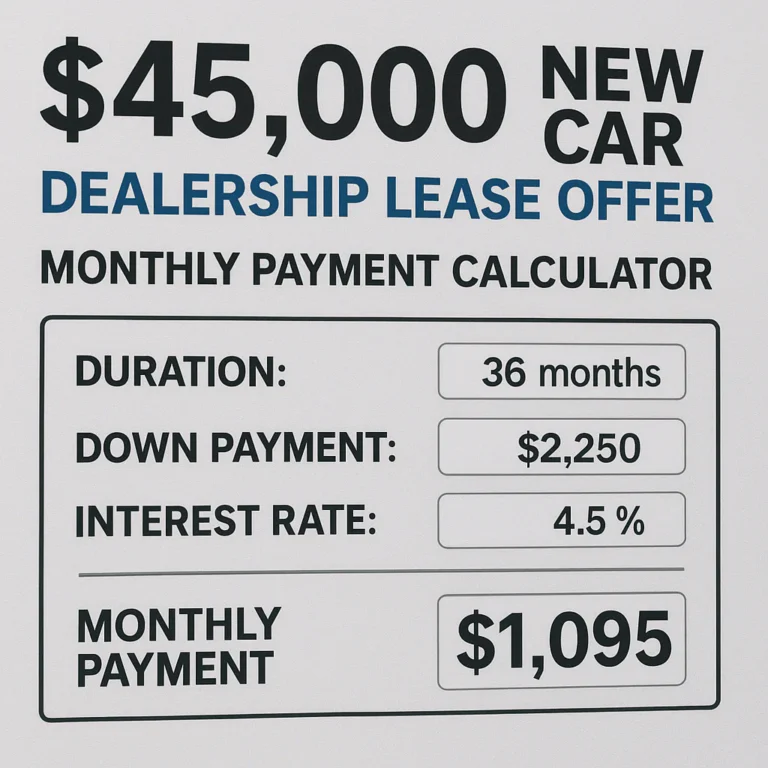
For another example of how vehicle price affects a payment, see our guide to how much a lease on a $45,000 car might cost. The actual payment depends on the selling price, residual value, lease rate, term, taxes, and fees—not the sticker price alone.
| Lease cost | What to include | Where it usually appears |
|---|---|---|
| Monthly payment | Depreciation, rent charge, applicable tax | Monthly bill |
| Due at signing | First payment, down payment, fees, possible taxes | Lease contract or itemized quote |
| Other upfront costs | Registration, title, delivery, dealer fees | Due at signing, or sometimes rolled into the lease |
| Lease-end costs | Excess mileage, excess wear, disposition fee, remaining obligations | Return inspection or final statement |
| Optional costs | Insurance, maintenance, tires, charging or fuel | Your household budget, not always the lease contract |
Quick calculation:
Total lease cost = upfront costs + (monthly payment × number of payments) + expected lease-end charges
This estimates your cash outlay over the lease. For a useful comparison with buying, calculate lease-related insurance and maintenance separately, since those expenses may not be included in the quoted lease payment.
A few practical rules from our lease-shopping experience:
- ✅ Ask for the selling price, residual value, money factor, term, mileage allowance, fees, taxes, and amount due at signing in writing.
- ✅ Compare offers using the same vehicle, term, mileage allowance, and cash due at signing.
- ✅ Check whether a quote’s “monthly payment” includes tax.
- ❌ Don’t treat a low payment created by a large down payment as automatically cheaper.
- ❌ Don’t assume every state taxes a lease the same way.
- ✅ Use a calculator for an estimate, then verify the contract line by line.
The payment formula is a helpful start. But the number that matters most is the total after all the small print has had its say.
🚘 Car Leasing Basics: What You’re Paying For

A lease is a contract that lets you use a vehicle for an agreed period and mileage allowance. The lessor—often a manufacturer’s finance company or a bank—sets the contract terms. You generally pay for the vehicle’s expected depreciation during the lease, plus a financing charge, taxes, and applicable fees.
The Federal Reserve describes leasing as paying for the vehicle’s depreciation during the term, along with rent charges and fees. That’s why a lease with a relatively high residual value can have a lower payment than a similar vehicle expected to lose more value. See the Federal Reserve’s consumer guide to vehicle leasing and our Car Lease Basics for more background.
How a Lease Payment Is Calculated
Most simplified lease calculators break a payment into three parts:
- Depreciation: The adjusted amount used to calculate the lease minus the estimated value at lease-end, spread across the lease months.
- Rent charge: A financing charge calculated using the adjusted capitalized cost, residual value, and money factor.
- Tax: Applied according to your state and local rules.
A common simplified formula is:
Adjusted cap cost = negotiated price + fees rolled into the lease
 − rebates − cap-cost reduction

Monthly depreciation = (adjusted cap cost − residual value) ÷ lease months

Monthly rent charge = (adjusted cap cost + residual value) × money factor

Estimated pretax payment = monthly depreciation + monthly rent charge
``

Tax is then added according to local rules. This formula is a useful estimate, not a substitute for your leasing company’s official worksheet: some taxes and fees are handled upfront, and local tax treatment varies.

The calculator at [Calculator.net](https://www.calculator.net/auto-lease-calculator.html) presents a similar depreciation-and-rent-charge approach. The [Southeast Toyota Finance lease calculation guide](https://www.setf.com/leasing/leasing-calculations) also lays out depreciation, rent charge, and tax as separate components. Their examples may handle fees differently, so always check whether a calculator assumes fees are included in the cap cost or paid separately.

### [Lease Costs Versus Buying a Car](#lease-costs-versus-buying-a-car)

Leasing may suit drivers who value a newer car, predictable contract terms, and a planned replacement cycle. Buying may make more sense if you drive a lot, want to keep the same car for many years, or prefer building ownership equity.

| Consideration | Leasing | Buying |
|---|---|---|
| What payments primarily cover | Use and depreciation during the term, plus financing and fees | Loan balance, interest, and eventually ownership |
| Mileage | Contract limit; excess miles may trigger a charge | Usually no mileage penalty |
| Condition | Wear standards apply at return | You choose when and how to repair or sell |
| At the end | Return, buy out if allowed, or enter another lease | Keep, trade, or sell the vehicle |
| Best fit to consider | Drivers who want regular vehicle changes and predictable mileage | Drivers who keep vehicles longer or drive high annual mileage |

Neither option wins for everyone. Compare the lease’s total cost with the financing cost, expected resale value, insurance, maintenance, and how long you realistically keep a vehicle. Our [Auto Financing Options](https://www.carleases.org/category/auto-financing-options/) guide can help frame the buy-versus-lease comparison.

## [🧮 How to Calculate the Total Cost of Leasing a Car](#how-to-calculate-the-total-cost-of-leasing-a-car)

Work through the numbers in order. The first thing we ask for is not “What’s the monthly payment?” It’s the full structure behind that payment.

### [1. Find the Vehicle’s Negotiated Selling Price](#1-find-the-vehicles-negotiated-selling-price)

Start with the agreed selling price, sometimes called the **capitalized cost** or **cap cost**. It may be lower than MSRP after negotiation, manufacturer incentives, or dealer discounts.

Ask the dealer for these figures separately:

- MSRP and exact vehicle trim
- Negotiated selling price before incentives
- Rebates or lease cash
- Dealer-installed accessories
- Any fees added to the vehicle price

Negotiate the vehicle price before discussing how to make the payment look attractive. A lower selling price can reduce the depreciation portion and may also reduce the rent charge. Incentives can change the calculation, so verify eligibility and whether the advertised offer applies to your location and customer profile.

### [2. Account for the Capitalized Cost Reduction](#2-account-for-the-capitalized-cost-reduction)

The **adjusted capitalized cost** is the figure used in the payment calculation. It often includes the negotiated price plus fees rolled into the lease, minus qualifying rebates and other reductions.

```text
Adjusted cap cost =
negotiated selling price
+ fees and add-ons included in the lease
− rebates or incentives
− eligible trade-in equity
− cap-cost reduction
``

A down payment made to reduce the cap cost is often called a **capitalized cost reduction**. It lowers the monthly payment, but it also means you have paid more cash at the start. For an apples-to-aples comparison, always record both the monthly payment and the cash due at signing.

Trade-in equity can also reduce the cap cost, but ask for the trade-in value and the lease deal separately. Combining them in one payment can make it harder to see whether you’re getting a fair offer for your old vehicle.

### [3. Calculate Depreciation and the Residual Value](#3-calculate-depreciation-and-the-residual-value)

The **residual value** is the leasing company’s estimate of what the vehicle will be worth at the end of the lease. It is often shown as a dollar amount and may be derived from a percentage of MSRP.

```text
Residual value = MSRP × residual percentage
Monthly depreciation = (adjusted cap cost − residual value) ÷ lease months
``

For example, if the adjusted cap cost is higher and the residual stays the same, the amount of depreciation you pay increases. If the residual is higher, the amount of depreciation charged during the term decreases.

Residuals are generally set by the leasing company, not negotiated like the vehicle’s selling price. They can vary by term, mileage allowance, model, and lender. A strong residual can help make a lease payment lower, but it does **not** automatically mean the vehicle is a better overall deal. Confirm that competing quotes use the same mileage and term.

### [4. Add the Rent Charge and Money Factor](#4-add-the-rent-charge-and-money-factor)

A lease’s financing charge is often expressed as a **money factor**. It looks like a small decimal, such as `0.00200`. A common approximate conversion is:

```text
Approximate APR = money factor × 2,400
Money factor ≈ APR ÷ 2,400
``

For instance, a money factor of `0.00200` corresponds to an approximate 4.8% APR using this rule of thumb. The conversion is an approximation for comparing lease financing; the official contract and lender disclosures control.

A simplified monthly rent-charge formula is:

```text
Monthly rent charge = (adjusted cap cost + residual value) × money factor
``

This is the standard estimate shown by several consumer lease calculators, including [Calculator.net](https://www.calculator.net/auto-lease-calculator.html). Ask the dealer to disclose the **money factor in writing** and whether it is the lender’s base rate or includes a markup. Approval tier and lender programs can affect the offered rate.

### [5. Include Sales Tax on Lease Payments](#5-include-sales-tax-on-lease-payments)

Sales tax treatment depends on where the vehicle is registered and how that jurisdiction taxes leases. Some places tax each payment; others may collect tax differently, including on more of the vehicle’s value. Local rules can also affect tax on rebates, fees, and trade-in credit.

For a simple estimate in a location that taxes the monthly payment:

```text
Monthly tax = pretax monthly payment × applicable tax rate
Monthly payment with tax = pretax monthly payment + monthly tax
``

Do not apply that formula blindly. Check your state’s official revenue agency guidance or ask the dealer for the tax calculation and taxable base. The [Tax Foundation’s state sales tax information](https://taxfoundation.org/data/all/state/sales-tax-rates-2025/) can provide broad context, but your state and local tax authority is the source to trust for the actual lease rules.

### [6. Add Upfront Fees, Registration, and Delivery Charges](#6-add-upfront-fes-registration-and-delivery-charges)

A lease quote may show a monthly payment alongside a separate **amount due at signing**. That due-at-signing amount can include the first payment, acquisition fee, registration, title, taxes, documentation charges, and a down payment.

Ask for an itemized drive-off breakdown. For every charge, find out whether it is:

- **Paid upfront**
- **Roled into the adjusted cap cost**
- **Included in the advertised payment**
- **Optional**
- **A government charge or a dealer charge**

Rolling a fee into the lease can reduce the cash needed at signing, but it may increase the amount used to calculate depreciation and rent charges. Paying upfront avoids financing that fee, but increases your initial outlay. The right comparison is the total cash cost, not which payment structure looks prettier on the showroom worksheet.

### [7. Include End-of-Lease and Mileage Costs](#7-include-end-of-lease-and-mileage-costs)

Your estimate should include expected lease-end charges where applicable:

- Excess-mileage charges
- Excess wear-and-tear costs
- Disposition fee when returning the vehicle
- Unpaid payments or other contractual charges
- Any remaining amount due if you end the lease early

Mileage allowances and per-mile rates differ by contract. Before signing, check the annual allowance, total allowance, and the exact charge for excess miles in your lease paperwork. A driver who routinely travels more than the allowance may better off asking for a higher-mileage lease upfront or comparing buying instead.

Wear standards also vary. Take photos of the car before return, review the lessor’s inspection guidance, and ask what counts as ordinary wear. The [Federal Trade Commission’s vehicle leasing guidance](https://consumer.ftc.gov/articles/lease-or-buy-new-car) explains that mileage limits and condition requirements can affect the cost of returning a leased vehicle.

## [📋 Every Car Lease Fee to Check Before You Sign](#every-car-lease-fe-to-check-before-you-sign)

Fees are not all created equal. Some are set by a government agency, some by the lender, and some by the dealer. Ask for an itemized quote and challenge unclear charges politely but directly.

| Fee or cost | What it covers | What to check |
|---|---|---|
| Acquisition fee | Lender’s lease origination or processing charge | Whether it’s paid upfront or added to cap cost |
| Documentation fee | Dealer paperwork and processing | Local rules, amount, and whether it is negotiable |
| Registration and title | Government registration and ownership records | Whether the amount is an estimate or exact |
| Delivery or destination | Manufacturer’s vehicle transportation charge | Whether already included in MSRP |
| Disposition fee | Return processing at lease-end | Whether it applies and if a qualifying replacement lease waives it |
| Excess mileage | Miles over contract allowance | Exact per-mile rate and any pre-purchase option |
| Excess wear | Damage beyond contract standards | Inspection process and written wear guidelines |
| Optional products | Protection plans, service contracts, accessories | Whether you chose it and whether it is required |

### [Acquisition, Documentation, and Dealer Fees](#acquisition-documentation-and-dealer-fes)

An acquisition fee is usually tied to the leasing company’s contract. Dealers may allow it to be paid upfront or included in the lease, but whether it can be waived or changed depends on the lender and program.

Documentation fees are dealer charges and can be subject to state rules. If the dealer says a fee is mandatory, ask whether it is required by law, required by the lender, or simply part of that dealer’s standard paperwork. You may not be able to remove a fixed dealership fee, but you can still negotiate the vehicle’s selling price.

Never double-count the destination charge. It is commonly included in the vehicle’s displayed MSRP, so check the worksheet before adding it again.

### [Registration, Title, and Government Fees](#registration-title-and-government-fes)

Title and registration costs are generally tied to where you register the vehicle. They can vary by state, county, vehicle type, and registration period. Request an itemized estimate, then verify it with your state’s motor vehicle agency.

If these charges are rolled into the lease, ask whether they become part of the cap cost. If paid at signing, include them in your upfront total. Either way, they belong in your all-in calculation.

### [Disposition, Excess Mileage, and Wear-and-Tear Fees](#disposition-excess-mileage-and-wear-and-tear-fes)

A disposition fee may be charged when you return the vehicle, though some lessors waive it if you lease or buy another vehicle of the same brand. Check the contract rather than relying on a salesperson’s general statement.

To estimate mileage exposure:

```text
Potential mileage charge =
(maximum expected miles − contract allowance) × per-mile charge
``

This is only a planning estimate. The contract determines the actual allowance and rate. If you expect to exceed the limit, compare the cost of buying additional miles in advance with the end-of-lease charge.

For wear-and-tear, ask for the inspection standards before delivery—not on return day, when the car has already collected a few years of parking-lot stories. Normal wear and chargeable damage are contract-defined, so get the lessor’s guide in writing.

### [Optional Products and Add-Ons](#optional-products-and-add-ons)

Protection packages, tire-and-wheel coverage, prepaid maintenance, and accessories can add to the cap cost or amount due at signing. Some may be useful for your situation; none should be assumed mandatory without clear contract support.

Before accepting an add-on:

- Ask for its full cost and what it covers.
- Check exclusions, deductibles, cancellation terms, and coverage limits.
- Compare it with your existing insurance or manufacturer warranty.
- Confirm whether it raises the lease payment or is paid separately.

If a dealer advertises a payment that depends on a particular add-on, ask for the payment without it. Then compare the total contract cost.

## [🧾 Taxes on a Leased Car: State-by-State Differences](#taxes-on-a-leased-car-state-by-state-diferences)

Lease tax rules can make two otherwise identical offers differ. Tax might be charged on monthly payments, on an upfront amount, or under another state-specific method. Cities and counties may add local taxes.

The key question is not simply, “What is the tax rate?” Ask: **What amount is taxable, when is it collected, and which tax rate applies?**

### [Tax on Monthly Payments Versus the Full Vehicle Price](#tax-on-monthly-payments-versus-the-full-vehicle-price)

Some jurisdictions generally tax the lease payments as they come due. Others can tax a different base or collect more tax upfront. Rules may also differ for tax on rebates, trade-in credit, fees, and the vehicle’s initial value.

The [Southeast Toyota Finance calculation guide](https://www.setf.com/leasing/leasing-calculations) notes that tax rules vary by location and describes tax as part of the payment calculation in its example. That is a useful illustration, not a universal rule. Confirm the treatment with your state’s department of revenue and the leasing company.

### [Upfront Taxes, Trade-Ins, and Tax Credits](#upfront-taxes-trade-ins-and-tax-credits)

A trade-in may affect the taxable amount in some jurisdictions, while in others it may not reduce lease taxes in the same way—or at all. Incentives can also have different tax treatment depending on local rules and how the transaction is structured.

Ask the dealer to identify:

- The taxable base
- The state and local rates used
- Any tax charged at signing
- Whether taxes are included in the monthly payment
- How rebates and trade-in credit are treated

If the quote just says “taxes included,” ask for the calculation. A clear answer should identify the amount taxed and the applicable rate.

## [🔢 Worked Example: Estimating the All-In Lease Cost](#worked-example-estimating-the-all-in-lease-cost)

The following example illustrates the math, not a current offer or quote. It uses the calculation approach published by [Calculator.net](https://www.calculator.net/auto-lease-calculator.html), with figures chosen to show how the pieces fit together.

Assumptions:

| Input | Example assumption |
|---|---:|
| Negotiated vehicle price | $50,000 |
| Down payment applied to cap cost | $8,000 |
| Trade-in equity applied to cap cost | $5,000 |
| Residual value at lease-end | $25,000 |
| Lease term | 36 months |
| Approximate APR | 6% |
| Illustrative tax rate on payment | 6% |
| Fees | Assumed included in vehicle price or otherwise excluded from this simplified calculation |

**Important:** This example intentionally leaves out itemized upfront and end-of-lease fees. Add those separately for a complete all-in estimate, and confirm your local tax treatment.

### [Monthly Payment, Drive-Off Amount, and Total Cost](#monthly-payment-drive-off-amount-and-total-cost)

**Step 1: Calculate adjusted cap cost**

```text
$50,000 − $8,000 − $5,000 = $37,000
``

**Step 2: Calculate monthly depreciation**

```text
($37,000 − $25,000) ÷ 36 = $333.33 per month
``

**Step 3: Convert the approximate APR to a money factor**

```text
6% ÷ 2,400 = 0.0025
``

**Step 4: Estimate the monthly rent charge**

```text
($37,000 + $25,000) × 0.0025 = $155 per month
``

**Step 5: Estimate tax**

```text
($333.33 + $155) × 6% = $29.30 per month
``

**Estimated monthly payment:**

```text
$333.33 + $155 + $29.30 = $517.63
``

Now distinguish the **monthly payment** from the **total lease outlay**. In this simplified example, the $8,000 down payment and $5,000 trade-in equity are applied upfront as cap-cost reductions. If the 36 payments are each $517.63:

```text
36 × $517.63 = $18,634.68 in estimated monthly payments
$18,634.68 + $8,000 cash down = $26,634.68 estimated outlay
``

The $5,000 trade-in equity is value you contributed, even though it is not cash handed over at signing. Counting it gives a broader view of what went into the lease:

```text
$26,634.68 + $5,000 trade-in equity = $31,634.68
``

These totals still exclude any fees not already included, and they assume the tax treatment in the example. If the upfront amounts were structured differently, the monthly payment would change. That is why we recommend comparing both the monthly figure and the complete cash-plus-equity outlay.

### [How Rebates, Down Payments, and Fees Change the Result](#how-rebates-down-payments-and-fes-change-the-result)

A rebate that reduces the cap cost can lower the estimated depreciation and may affect the rent charge. A down payment can do the same, but it shifts your cost to the beginning of the lease rather than eliminating it.

Fees affect the outcome based on where they appear:

- **Roled into cap cost:** They may increase the lease payment and financing charge.
- **Paid upfront:** They increase the amount due at signing.
- **Included in the quoted payment:** They may be easy to miss unless the quote is itemized.
- **Not included in the quote:** They still belong in your total-cost estimate.

The [OnlyCalculators lease calculator guide](https://www.onlycalculators.com/finance/personal-finance/car-lease-calculator/) similarly separates adjusted cap cost, depreciation, rent charge, and tax. Its treatment is useful for understanding the pieces, but its assumptions may not match your contract. Use a calculator to check arithmetic; use the lease agreement to confirm the actual obligations.

## [🖩 Lease Calculator: What the Numbers Mean](#lease-calculator-what-the-numbers-mean)

Online calculators are excellent for testing scenarios: What if you negotiate the selling price lower? What if you choose more miles? What if the dealer’s money factor is higher than the lender’s base rate?

Try [Calculator.net’s auto lease calculator](https://www.calculator.net/auto-lease-calculator.html) or review the [Southeast Toyota Finance calculation guide](https://www.setf.com/leasing/leasing-calculations). Treat the result as an estimate, especially if the calculator assumes a particular tax method or fee structure.

### [Inputs to Gather Before Using a Lease Calculator](#inputs-to-gather-before-using-a-lease-calculator)

Have these figures ready:

- MSRP and negotiated selling price
- Rebates and incentives you qualify for
- Adjusted cap cost or the items that determine it
- Residual value, in dollars or as a percentage of MSRP
- Lease term in months
- Money factor or disclosed lease rate
- Annual mileage allowance
- Applicable tax rate and how your location applies it
- Fees paid upfront versus rolled into the lease
- Cash due at signing, including first payment
- Trade-in equity and any cap-cost reduction

If a dealer will not provide the money factor or residual, ask for the itemized lease worksheet. A payment alone is not enough information to verify a quote.

### [What a Lease Calculator Includes—and What It May Miss](#what-a-lease-calculator-includesand-what-it-may-miss)

Most calculators estimate monthly depreciation and rent charge. Depending on the tool, they may also estimate taxes and fees. They often do **not** automatically account for:

- Every state’s tax method
- Dealer documentation or electronic filing fees
- Upfront registration and title charges
- Optional products and accessories
- Mileage penalties or wear charges
- Insurance, fuel or electricity, tires, and maintenance
- Early termination terms or disposition fees

Read the calculator’s assumptions before entering numbers. For instance, a calculator may assume fees are included in the vehicle price, while your dealer quote lists them separately. That difference can make two apparently matching estimates diverge.

For a lease-negotiation walkthrough, the [featured CarEdge video](#featured-video), “Don’t Get SCREWED on a Car Lease | 3 GOLDEN RULES to Negotiate a Car Lease,” can be a helpful companion to the number-crunching. Its focus is negotiating the offer; use it alongside your own itemized quote and contract.

## [📊 Compare Lease Offers by Total Cost, Not Monthly Payment](#compare-lease-offers-by-total-cost-not-monthly-payment)

Two offers can show the same monthly payment and still cost very different amounts overall. One might require more money at signing, include fewer miles, or exclude tax. Compare the contract structure, not the headline.

A useful comparison worksheet:

| Item | Offer A | Offer B |
|---|---|---|
| Vehicle and trim | | |
| Negotiated selling price | | |
| Lease term | | |
| Annual mileage allowance | | |
| Residual value | | |
| Money factor | | |
| Monthly payment, including tax? | | |
| Amount due at signing | | |
| Fees rolled into cap cost | | |
| Expected lease-end charges | | |
| Total estimated cost | | |

### [How to Compare Different Terms and Mileage Limits](#how-to-compare-different-terms-and-mileage-limits)

Compare identical terms where possible. A shorter lease can have a different residual, money factor, and payment structure. A higher annual mileage allowance may increase the payment because the residual is expected to be lower.

When the offers aren’t identical, estimate the total cost over each full term:

```text
Estimated total cost =
cash due at signing
+ monthly payment × number of payments
+ expected end-of-lease charges
``

Then separately consider the number of months of vehicle use and your likely mileage. A longer lease may have a lower-looking monthly payment but keep you in the contract longer; a low-mileage offer may become expensive if your commute has other plans.

Drivers considering an electric model can compare lease-specific incentives and mileage needs in our [Electric Vehicle Leases](https://www.carleases.org/category/electric-vehicle-leases/) section. Check manufacturer terms directly, since incentives and programs can change.

### [Questions to Ask the Dealer About Fees and Taxes](#questions-to-ask-the-dealer-about-fes-and-taxes)

Bring these questions to the conversation:

- Is the quoted payment **with tax**?
- What is the negotiated selling price before rebates?
- Which rebates are included, and do I qualify?
- What are the residual value and money factor?
- Is the money factor the lender’s base rate?
- What is the total due at signing, itemized?
- Which fees are rolled into the cap cost?
- What is the mileage allowance and excess-mile rate?
- Is there a disposition fee?
- What are the return-condition standards?
- Can I see the full lease worksheet and contract before signing?

We also like to ask for the quote by email. A written offer is easier to compare than a payment scribled on a worksheet while someone says, “This deal is only good today.”

## [💡 Ways to Lower Your Total Lease Cost](#ways-to-lower-your-total-lease-cost)

The most effective savings usually come from the numbers that feed the calculation—not from negotiating a monthly payment in isolation.

### [Negotiate the Vehicle Price and Money Factor](#negotiate-the-vehicle-price-and-money-factor)

Negotiate the selling price just as carefully as you would if buying. A lower cap cost can reduce depreciation and the rent charge. Then verify the money factor against the lender’s current program and your credit approval tier.

Be cautious about lease ads that highlight a payment but hide a large amount due at signing. Ask for the full structure and compare it with an offer that uses less upfront cash. For more on approval factors, see our [Credit Score and Car Leasing](https://www.carleases.org/category/credit-score-and-car-leasing/) guide.

### [Choose the Right Term and Annual Mileage Allowance](#choose-the-right-term-and-annual-mileage-allowance)

Estimate your annual driving using real records, not optimism. Include commuting, errands, holidays, and the occasional “quick trip” that somehow adds a few hundred miles.

A sensible mileage allowance can help avoid a costly surprise at return. Ask whether purchasing additional miles upfront is available and compare that cost with the contract’s excess-mile rate. For term comparisons and planning, see our [Best Lease Terms](https://www.carleases.org/category/best-lease-terms/) resources.

### [Why a Large Lease Down Payment Can Be Risky](#why-a-large-lease-down-payment-can-be-risky)

A large upfront payment lowers the monthly figure, but it does not necessarily lower the underlying total cost by the amount the payment suggests. It also puts more of your money into the vehicle at the start.

If the leased vehicle is totaled or stolen, how a down payment is treated depends on the lease contract, insurance settlement, and any gap coverage. Don’t assume your upfront cap-cost reduction will automatically be returned. Ask the lessor and insurer how the scenario would work, and consider keeping the drive-off amount limited to required fees and the first payment.

### [⚠️ Common Lease-Cost Calculation Mistakes](#common-lease-cost-calculation-mistakes)

Avoid these frequent miscalculations:

- **Comparing payments without comparing cash due at signing.** A lower payment can be subsidized by a larger upfront contribution.
- **Forgetting taxes.** Confirm whether the displayed payment includes them and how your location taxes leases.
- **Treating the residual as a negotiated selling price.** The selling price is usually the negotiable starting point; residual values are set by the lender.
- **Using the wrong money-factor conversion.** For a rough APR comparison, multiply the money factor by 2,400; don’t confuse a decimal money factor with an APR percentage.
- **Ignoring rolled-in fees.** They may increase the adjusted cap cost and therefore the payment.
- **Counting rebates twice.** Make sure an incentive has not already been deducted from the quoted price.
- **Forgetting lease-end obligations.** Mileage, wear, and disposition charges may apply.
- **Assuming every calculator uses the same tax method.** Check its assumptions and validate with official state guidance.
- **Ignoring trade-in equity.** It is value you contribute, even if it doesn’t leave your bank account as cash.
- **Focusing only on the monthly payment.** Calculate total lease outlay, then compare it with your alternatives.

The safest final check is simple: take the itemized quote, recreate the calculation, and ask the dealer to explain every difference.